
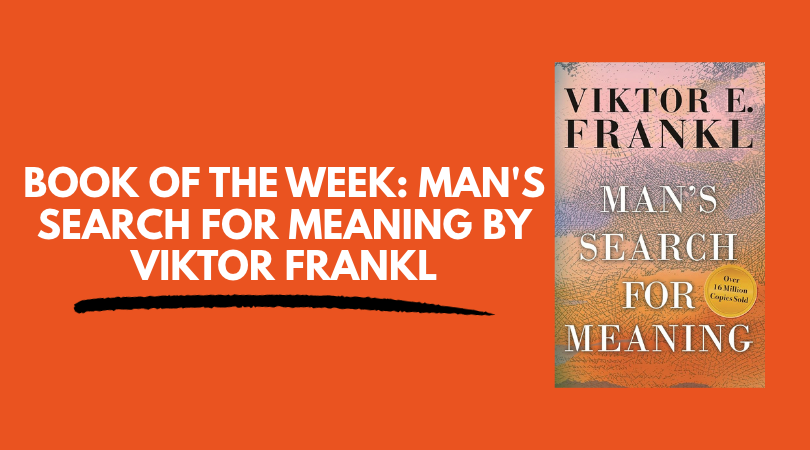
Book of the Week: Man’s Search for Meaning by Viktor Frankl
What do presidents, pro athletes, social media stars, and half the podcasters on your phone have in common?
They all told me to read the same book. For years.
And for years, I nodded, said “yeah, it’s on my list,” and went and read something else. Man’s Search for Meaning sat on my to-read list so long it should have been paying rent.
Why did I dodge it? Honestly, because everybody talks about it. It’s one of those “must read” books that people recommend without ever really telling you why. You hear the title so many times it starts to feel like homework. Like broccoli. You know it’s good for you. You’re just not in a hurry.
Well, I finally picked it up. And I could not put it down.
It’s about 165 pages. You can knock it out in a few hours. But those few hours will follow you around for a lot longer than that. This book is a page turner, a heart stopper, and an eyebrow raiser all in one. And now I get it. Now I’m the guy telling you to read it.
The Book in a Nutshell
Viktor Frankl was a psychiatrist in Vienna. Then he became prisoner number 119104. He survived Auschwitz and Dachau, lost his wife, his parents, and his brother, and came out the other side with something most of us spend our whole lives chasing. A reason.
The first part of the book is his account of life in the camps. The second part is the theory he built from it, called logotherapy. Big word, simple idea. The main thing that drives a human being isn’t pleasure or power. It’s meaning. Give a person a why, and they can survive almost any how.
That’s it. That’s the whole engine. And it runs on fuel nobody can confiscate.
The Soup, the Shoes, and the Stuff Nobody Talks About
There are scenes in this book that will stop you cold. The soup is one of them. When your whole day comes down to whether the guy with the ladle dips from the top of the pot or scoops from the bottom where the few peas are hiding, you start to understand how small the world can get. The shoes are another. Wet, frozen, swollen feet jammed into broken shoes, marching out to work in the snow. You’ll never complain about your work boots again. Trust me.
But here’s what hit me hardest, and it’s the part I almost never hear anyone mention when they talk about this book.
The hope.
Inside the torture, the starvation, and the flat out cruelty, these people kept hoping. Every day the sun came up. They greeted each other. They greeted the new day. And they set out on the journey again. There’s a moment where exhausted, starving prisoners stop what they’re doing just to watch a sunset. Think about that. Men who had nothing left still made time to notice something beautiful.
Many of them never wavered from their beliefs, even when some of them wavered from life itself. Some simply gave up. Frankl describes it. A man would stop getting up. He would smoke the cigarettes he’d been saving to trade for food, and everyone knew what that meant. And who are we to blame them? They had been through a hell most of us couldn’t even picture. They deserved the reprieve.
How does something like this happen? How does a society get to the point where it tries to wipe an entire people off the face of the earth? Why these people? You read it, and you still can’t wrap your brain around it. I don’t think you’re supposed to. I think you’re supposed to remember it.
Work Is Worship
Years ago, a rabbi told me something I’ve never forgotten. In Hebrew, the word for work and the word for worship is the same word. Avodah.
That stopped me in my tracks. It made me look at how hard Jewish folks work and understand the why behind it. When your work is a form of worship, you don’t punch a clock. You show up with your whole heart. That’s one of their superpowers.
Now hold that idea and walk back into the camps with it.
These people were ripped away from their families and forced into labor. And every single day, with every shovel and every step, there were whispers in their heads and hearts. Prayers. They never gave up their spirituality. They could not be stripped of it.
The armies ended the war. But I believe it was the faith, the prayers, and the beliefs these people refused to let go of that kept them alive inside it. You can take a man’s shoes. You can take his name and give him a number. You can’t take what he holds onto in his heart.
Attitude Is the Light Switch
Frankl’s big idea is that everything can be taken from you except one thing. He calls it “the last of the human freedoms.” Your freedom to choose your attitude, no matter the circumstances.
Now let me be very clear. I’m not comparing cleaning windows to a concentration camp. Not even close. But I know a little something about choosing your attitude when nothing else is in your control.
I started cleaning windows at 17. No car. No money. Just a squeegee and a whole lot of stubborn. And those early broke days were rough. I wasn’t just short on cash. I was short on hope, and my attitude showed it.
Then I changed my attitude. And it was like flipping a switch and turning on a light. Everything got better. Financially and spiritually. Same squeegee. Same streets. Same me. Different attitude.
That’s the lesson Frankl paid an unthinkable price to teach. You can’t always control what shows up on your doorstep. You can always control who answers the door.
From Muscles to Mouth to Wisdom
Frankl survived in part by looking forward. He pictured himself after the war, standing in a lecture hall, teaching people what he’d learned. That future version of himself pulled him through the present.
I think about that a lot these days. I have learned to put the squeegee down. Not forever. I’m still the World’s Greatest Window Cleaner and I’ll arm wrestle anyone who says otherwise. But as you get older, you lose some strength and stamina. Your shoulders send you memos. So your job is to keep upgrading the tools. From muscles, to mouth, to insights and wisdom.
Early on, my value was how many windows I could clean before lunch. Now my value is how well I can communicate, lead, and teach the people on my team to do it better than I ever did. That’s a different kind of work. But it still counts as worship.
What’s your future lecture? What’s the version of you, five or ten years out, that’s pulling you through the hard days right now? If you don’t have one, this book will make you go find one.
When the Tribe Wins, Everybody Wins
This book shows the full range of human nature, and some of it isn’t pretty. When your own life is on the line, people can turn inward. Some prisoners disengaged and focused only on themselves. Others did the opposite. They poured more care and passion into the people around them. They gave away their last piece of bread.
Would I have survived? Honestly? Who knows. Anybody who tells you for certain how they’d hold up in there is selling something. I’d like to think I’d be the guy sharing the bread. But I wasn’t there. What I do know is that it all comes down to attitude.
And I know this. We live for each other. We’re happy when our tribe wins. We’re sad when our tribe loses. And there’s a special kind of camaraderie that comes from working side by side and solving problems that make all our lives better.
At Window Ninjas, I’ve seen it over and over. Winning creates success for everyone. The entire team. So be happy for your people. Elevate your tribe. Teach them how to succeed so the whole tribe wins. It’s simple. But it’s very difficult for a lot of people to actually do.
Learning to Sit With Sadness
This book teaches sadness. Not how to avoid it. How to embrace it.
Here’s the truth. We all learn to deal with grief eventually. Our emotions are different, and none of us knows how we’ll react until something calls our name and delivers grief right to our door. Frankl doesn’t pretend suffering is good. He just shows you that even suffering can carry meaning if you choose to find it there. And when you find joy in life, it brings you meaning. So does the opposite.
That’s not a sad message. That’s a powerful one.
Who Needs This Book?
Everybody. But I’ll get specific.
This should be required reading in school. In 6th grade. Again in 9th grade. And one more time as a senior in high school. Because each time you read it, you’ll be a different person, and it’ll teach you something different.
If you avoid the past, it will come back and kill you. Read it so we never forget. Read it so you understand what people are capable of, on both ends of the spectrum. And read it so the next time you think you’re having a bad day, you remember the guy who stopped to watch a sunset with nothing in his stomach and nothing on his feet.
The Golden Squeegee Rating

Man’s Search for Meaning gets 5.0 Golden Squeegees.
Why? Read it and you’ll see. It’s short enough to finish in an afternoon and deep enough to think about for the rest of your life. It will make you hug your family a little tighter, look at your work a little differently, and check your attitude every single morning. This is a book you read, and then read again. Then go sit somewhere quiet and think about your life, and how you would have handled being in their shoes.
Follow my journey at gabesalinas.com, subscribe on Substack, and connect with me on social media.
Keep Shining.
Gabe Salinas The World’s Greatest Window Cleaner
