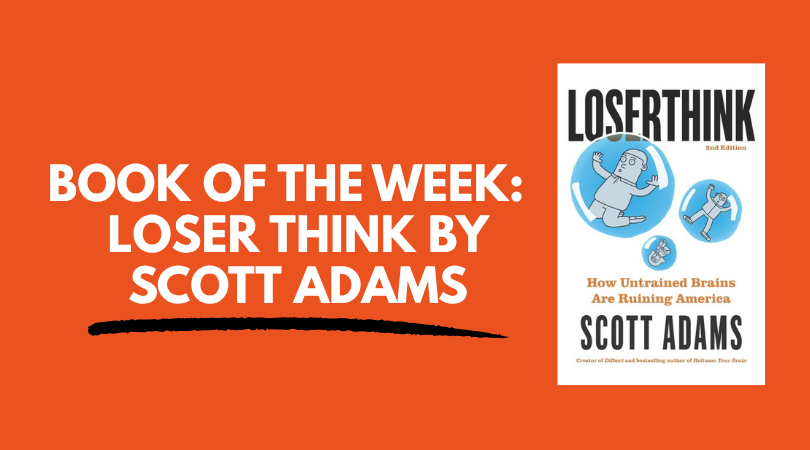
A Funny, Sharp, and Slightly Uncomfortable Look at the Dumb Thinking We All Do
Have you ever listened to somebody talk for ten minutes and thought, “This sounds confident… but it also sounds like a shopping cart with one bad wheel?”
That is part of what made Loser Think by Scott Adams such an interesting read.
This book is witty, funny, observant, and a little bit like a Dilbert comic that drank too much coffee and started calling people out at a board meeting. Scott Adams does a good job of pointing out the traps people fall into when they think emotionally, argue blindly, cling to weak logic, or pretend confidence is the same thing as competence.
What makes the book good is that it is not just about “those people.” It is about all of us. That is the part that stuck with me. We all fall victim to loserthink in one way or another. We all have moments where we think we are being rational, but really we are just defending our ego like a lawyer trying to protect a guilty client. I agreed with some of what he wrote, disagreed with some of it too, but the bigger point still landed. If you understand what loserthink is, you start catching it in the wild, and worse, you start catching it in the mirror.
What the Book Is Really About
At its core, Loser Think is about flawed thinking patterns.
Scott Adams argues that a lot of people get stuck because they do not know how to think across disciplines. They may know a little about one area, but they lack the broader tools needed to understand how the world actually works. So instead of reasoning carefully, they default to emotional reactions, weak assumptions, or tribal nonsense.
In plain English, they start swinging at life with a pool noodle when they needed a toolbox.
That is what makes the book valuable. It teaches you to recognize bad patterns of thought, not just in politics or online arguments, but in everyday life, business, leadership, and decision-making. The idea is not to become some robotic genius who never gets anything wrong. The idea is to become more aware of how easily people, all people, can slip into sloppy thinking.
That includes me.
That includes you.
That includes the guy on Facebook who suddenly became an economist, biologist, philosopher, and constitutional expert between lunch and dinner.
Why It Hit Me
What stood out to me most was the reminder that we are all guilty of loserthink.
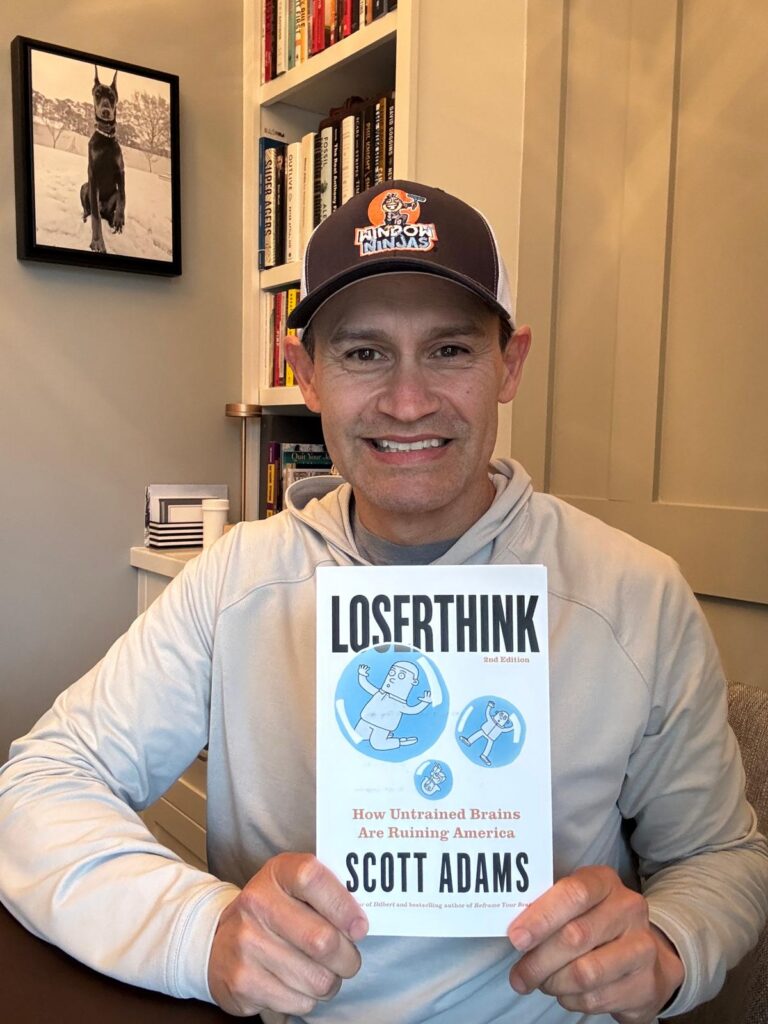
That is what makes the book more useful than just another author taking shots at the world. It is easy to read a book like this and start thinking of all the other people who need it. That neighbor. That employee. That cousin. That guy you know who talks like a podcast clip but thinks like a potato.
But the real value is realizing, “Wait a minute… I do this too.”
That is where the book becomes helpful.
Because once you understand loserthink, you start noticing the pitfalls:
you jump to conclusions,
you defend opinions you have not really examined,
you react emotionally before understanding the full picture,
you confuse certainty with intelligence,
and you sometimes fall in love with your own viewpoint just because it is yours.
That is human nature. Scott Adams just puts a spotlight on it with enough wit to make you laugh while you are being called out.
The Humor Makes the Lesson Go Down Easier
One reason I enjoyed this book is because it was witty the whole way through.
Some books give you good ideas, but reading them feels like chewing on drywall. Not this one. Loser Think has humor in it. It has edge. It has that dry, clever, sideways kind of writing that makes you grin while also thinking, “Well… dang it, he’s got a point.”
That matters.
A book like this could have easily turned into a lecture from some puffed-up intellectual trying to remind the rest of us how brilliant he is. Instead, it has a tone that keeps things moving. It feels more like a smart comic strip with teeth than a textbook. Like Dilbert wandered into a philosophy class, rolled his eyes, and started telling the truth.
That style works for me because it keeps the message from getting too heavy while still making the point stick.
Agreeing, Disagreeing, and Still Learning
I did not agree with everything in the book, and that is fine.
In fact, I think that is part of the point. A book does not have to be right about every single thing to make you think better. There were ideas in here that I nodded along with, and others where I thought, “I see what you are saying, but I am not buying all of that.”
That does not take away from the value.
If anything, it adds to it, because it forces you to think. It forces you to sort through what makes sense, what feels off, and what deserves more consideration. That is a whole lot better than reading something that just massages your ego and tells you everything you already believe.
Books should challenge you.
They should sharpen your thinking.
They should make you wrestle a little.
Otherwise, you are not reading, you are just spoon-feeding your own bias in hardcover form.
Why This Matters in Business and Life
This kind of thinking matters everywhere, especially in business.
Bad thinking creates bad decisions. Bad decisions create bad outcomes. Then people act shocked, like a guy who poured diesel into a lawn mower and cannot figure out why the backyard smells like a truck stop.
In business, Loserthink can show up fast. People make assumptions without enough facts. They blame the wrong problem. They get emotional instead of strategic. They defend old habits because those habits feel familiar. They confuse activity with progress. They hear one idea, fall in love with it, and stop asking whether it actually works.
That is dangerous.
The best leaders, salespeople, and business owners learn to question their own assumptions. They learn to separate feelings from facts. They learn to ask, “What is actually true here?” instead of just charging forward because they are convinced they are right.
That is what makes this book useful. It reminds you that better outcomes start with better thinking.
The Big Takeaway
My biggest takeaway from Loser Think is simple:
We all need to be more aware of the ways we fool ourselves.
Not just other people.
Ourselves.
That is where the growth is.
It is easy to spot broken thinking when it is wearing someone else’s pants. It is harder to notice when it is sitting at your own desk, drinking your coffee, and using your voice. This book helps you see those patterns more clearly. It makes you more aware of the traps, the assumptions, the mental laziness, and the blind spots that can quietly drag down your results.
And the best part is, Scott Adams delivers those reminders with enough humor and wit to keep the whole thing from feeling like a lecture from a miserable college professor in elbow patches.
Final Thoughts
Loser Think is funny, sharp, witty, and useful.
It is not a book I agreed with top to bottom, but it is a book I am glad I read. It challenges the reader to think more carefully, question more honestly, and recognize how easy it is for all of us to fall into bad mental habits. That alone makes it worth your time.
If you want a book that will make you laugh a little, think a lot, and occasionally feel like you just got smacked in the forehead with a Dilbert comic strip, this one delivers.
Golden Squeegee Rating: 4 out of 5

My takeaway: We are all guilty of loserthink at times. The goal is not to pretend we are above it. The goal is to recognize it faster, think better, and stop letting lazy thought patterns run the show.
That is a lesson worth carrying into business, leadership, relationships, and life.
Keep Shining.
