What happens when a man refuses to bend, and the whole world lines up to make him?
I ordered two books, not one.
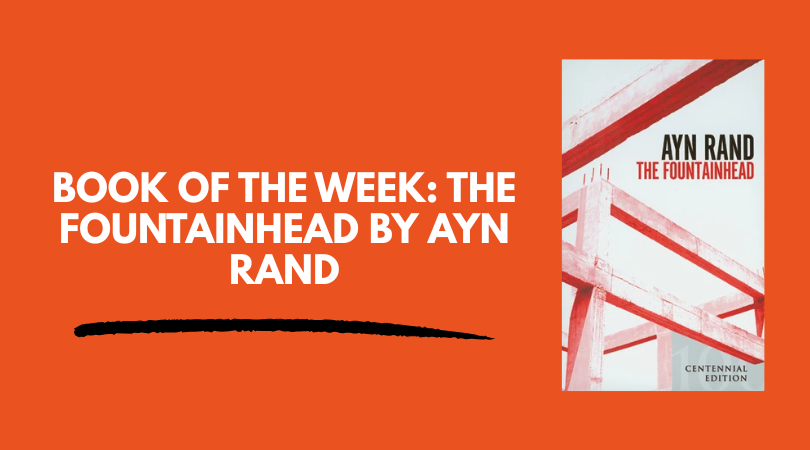
I kept hearing the same thing from every corner. You have to read Atlas Shrugged. So I did the thing I always do. I went big. I ordered the combo, Atlas Shrugged and The Fountainhead, both sitting on my desk like a dare. And then for some reason I still cannot explain, I reached past the famous one and picked up The Fountainhead first.
Best accident I have had in a while.
Because this book is not really about architecture. It is about drive. The kind of drive that makes a person do amazing things. And more than that, it is about where that drive comes from, and what a person is willing to pay to keep it.
Here is the idea that stopped me in my tracks. We all have desire. Every single one of us. But we do not use it the same way. Some people point their desire at building their own path, even when that path is the hardest one on the map. Other people point their desire at getting the crowd to clap. Same fuel. Completely different engine.
Meet Howard Roark. He is an architect who gets kicked out of school in the first chapter for one crime. He builds things his own way instead of the way everyone approves. That is the entire offense. He sees the building in his head, he knows it is right, and he will not change one line of it to make a committee comfortable.
Now meet Peter Keating. Same profession, opposite man. Keating builds whatever wins the award, marries whoever moves him up the ladder, and takes credit that is not his. On paper he is winning. Inside he is hollow, because he has no vision of his own. He is running on other people’s approval, and the second that approval stops, he is empty.
I read those two men and I saw something I have lived.
I have always pushed back on authority. I have always tried to build my own thing, my own way. And let me tell you, it is not the easy road. I have spent a good chunk of my life being looked at a little sideways for thinking differently, for seeing a problem differently than the room. For a long time I wondered if that was a flaw.
This book flipped it like a pancake.
Rand basically argues that the person who draws from inside himself is the source of every good thing ever built. The title says it. A fountainhead is the spring, the place the water comes up from the ground. Roark is a well. The water comes from within him. Keating is a bucket, useless until somebody fills it. And once you see that one difference, the whole cast of characters snaps into focus.
There is a critic named Ellsworth Toohey who preaches selflessness, not because he cares about anybody, but because a man who feels small and guilty is a man you can control. There is Dominique, who loves Roark so much she tries to destroy the thing she loves before the world can. And there is Gail Wynand, who clawed his way from nothing to a media empire, but bought his power by feeding the mob garbage instead of truth. Wynand is Roark if Roark had cut the deal. Reading his rise was one of the most impressive parts of the whole book.
All of this is happening against the backdrop of the Great Depression. And that is not an accident. When everybody is broke and scared, the message of “give yourself up to the group” sounds like salvation. Which is exactly why standing alone, like Roark, costs the most when times are the hardest.
Then Comes The Stand
Roark gets handed the one thing he wants most and the one thing that can break him, and they arrive in the same package. A massive public housing project called Cortlandt. He agrees to design it in secret and funnel it through Peter Keating, and he asks for nothing in return except one thing. It gets built exactly as he drew it. Not one line changed.
You can guess what happens. Committees happen. Well meaning men with red pens happen. They improve it. They bolt on their own ideas. They turn his clean design into a patchwork nobody owns, and they break the single condition he asked for.
So Roark blows it up. Dynamite. He levels the building he designed rather than let it stand as a lie.
Then he stands trial for it. He does not hide, he does not grovel, he does not let a slick lawyer sand down the edges. He defends himself, and he hands the courtroom the truth of the whole book. That everything great was built by people who worked for their own vision, that the creator owes the world the work and nothing beyond it, and that you cannot chain a man to other people’s needs and call the chain a virtue. He would rather destroy his own work than watch it live as a compromise.
And Here Is The Part That Hurt
Wynand, the man who finally decided to do one brave thing in his entire life, throws his whole empire behind Roark. And the crowd he spent decades feeding turns on him. His own paper revolts. His readers walk. And in the end Wynand folds. He caves. The one time he tried to stand for something true, the mob he built his power on crushed him for it.
Roark stands. Wynand breaks. Same storm, two men, and the only difference is where each one kept his scoreboard. Roark carried his inside his own chest, so nobody could move it. Wynand left his out in the crowd’s hands, and the crowd took it back.
Where Rand Lost Me A Little
I will not pretend a book is perfect just because it is great.
I cannot wrap my head around Roark letting go of Dominique. The woman he loves hands herself to other men, and he stays calm and waits it out. Me? Forget that. That is not calm to me. That is a kind of surrender I do not have in my body. And being friendly with Wynand, the man who bought the mob, and staying cool around Toohey, the devil in sheep’s clothing? Not me. I would have made Toohey’s life hard. I know that would have been the wrong move. I know it. But I am telling you the truth about the man writing this.
And maybe that is the whole point. Maybe Roark is not a real man. Maybe he is a sharpened ideal, the version of us with every ounce of neediness burned off. Real people fight. Real people flinch. I have been fighting my entire life, and I am only now, at this stage, learning to open my hands and show my palms instead of my fists. Roark starts the book with his palms already open. I do not fully believe a person can. But I believe in the direction he is pointing.
Why This One Hit Home
I grew up in a house of five. My dad always wondered where I came from. My sisters wondered too. My mom was the one who saw me for exactly who I was, and she still does to this day. The four of them would look at the safe path, the approved path, the obey authority path, and they would go right. Every time. And I went left. I ran left, fast, and I found out that sometimes the shorter path nobody is on turns out to be the better one.
I was not the smartest in that house. Not the wisest. But I had the most confidence, the biggest dreams, and a get it done at any cost motor that did not care much how everyone else said it should be done. I was the odd ball. And honestly, I still do not always see eye to eye with the people closest to me. I still refuse to bend. Just not the way I used to. I have learned to fight in a smarter manner now. Palms, not fists.
That is Roark to me. Not the dynamite. Not the courtroom. The quiet refusal to become someone else just because the room wants you to.
There is a lot of society and labor and collective politics tangled through this book, and the way I read it, Rand is showing how cruel that give yourself up to the group machine can be to the individual. I could be wrong. I am not the brightest bulb in the pack. But I will tell you what I always tell you. I may not be the brightest, but I am going to shine longer than the brightest bulb ever made.
Who Should Read It
Read this if you have ever been the one who went left while everybody else went right. If you have ever been the odd one in your own house. If you are building something your own way and you are tired of asking permission to do it. This book will not hand you comfort. It will hand you a mirror.
It is a heavy read. It is deep. It has a lot going on and you have to actually think and keep up, more than any average book will ever ask of you. I loved it for exactly that reason. It is one of my favorite reads now, not because it is easy, but because it teaches you something about yourself and about the people around you, if you keep your eyes open.
Maybe that is what Ayn wanted you to see all along.
The Golden Squeegee

Five out of five. No debate. It is dense, it is demanding, and it pays you back for every ounce of effort you put into it. A book that makes you think harder and see yourself clearer earns the top mark every time.
If this stirred something in you, come walk the journey with me. Follow along at gabesalinas.com, subscribe on Substack, and connect with me on social media. I read these on my morning walks so you do not have to wonder whether they are worth your time. This one is.
Next up, I finally crack open the book everybody pointed me toward in the first place. Atlas Shrugged. Buckle up.
Keep Shining.
