
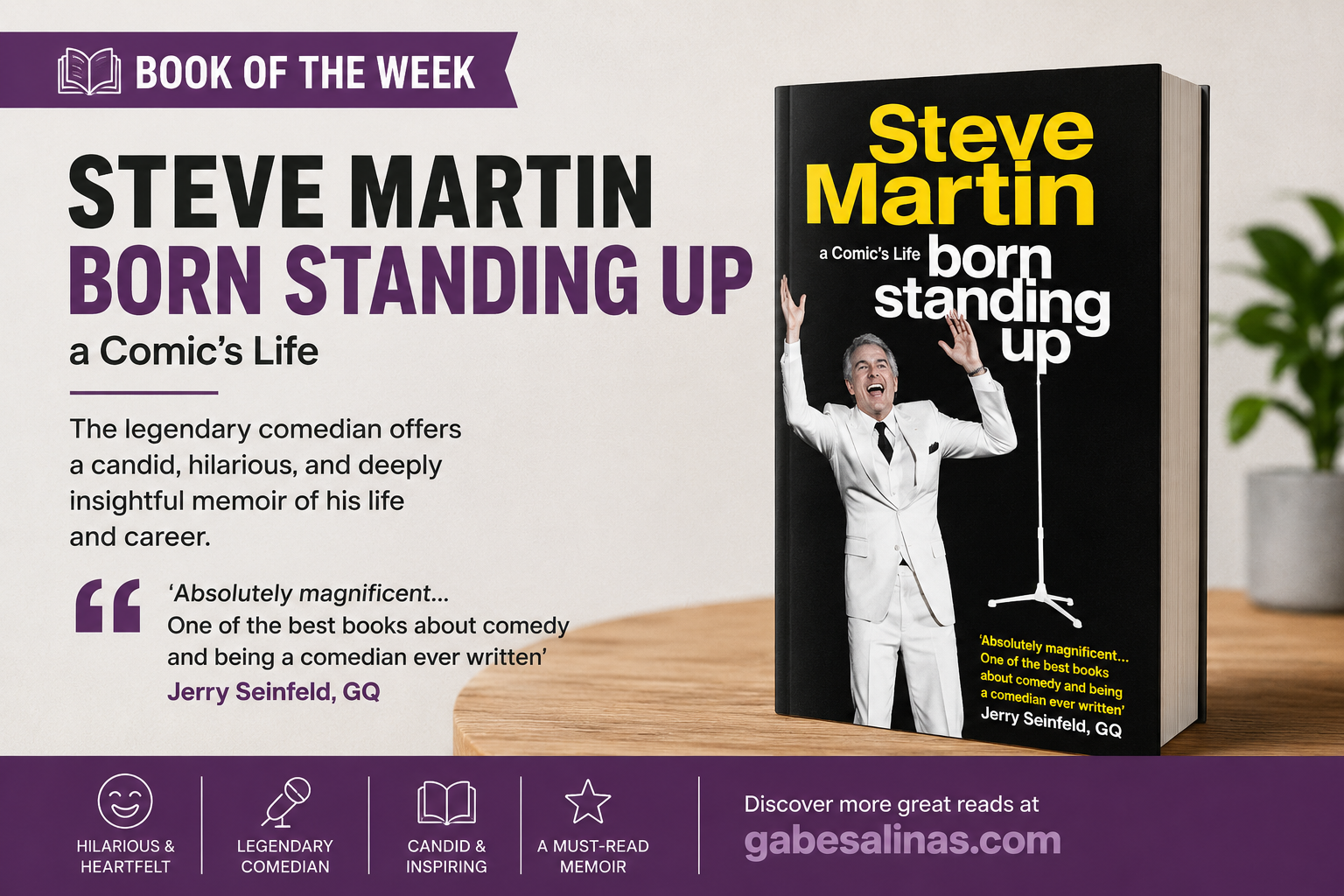
Have you ever picked up a book because you thought it was going to be one thing, but it ended up teaching you something completely different?
That was my experience with Born Standing Up by Steve Martin.
This book had been on my reading list for quite some time. A bunch of people had recommended it to me, and I have always been a fan of Steve Martin. I remember being a little boy watching him on Saturday Night Live. My dad was a big fan of his, and like a lot of things from childhood, his appreciation for Steve Martin rubbed off on me. Before long, I was laughing at the same wild and crazy guy my dad was laughing at.
I remember watching Steve in movies like Three Amigos and many others. He had this strange ability to be smart, silly, awkward, polished, ridiculous, and brilliant all at the same time. That is a hard combination to pull off. Most people who try to be silly just end up looking like they need medical attention. Steve Martin made it art.
He was not just telling jokes. He was building a character, a rhythm, a style, and a whole way of performing that was different from everyone else.
So naturally, when I picked up Born Standing Up, I thought I was about to read something fun, witty, and hilarious. I expected to laugh. I expected the Steve Martin I grew up watching. I expected a little banjo, a little nonsense, and maybe a few stories that made me spit coffee across the room.
And my first reaction was, “Why?”
Not “why did I read this?” but “why did this not feel like the Steve Martin I expected?”
Don’t get me wrong. The book is good. The backstory of how he became a comic was awesome. Reading about his early life, his family, his high school years, his time developing as a performer, and his eventual success on Saturday Night Live was interesting. There is a lot to appreciate in this book.
But I expected more humor.
I expected more of the Steve Martin I remembered from television and movies. I expected to laugh more. I expected more of the wild and crazy guy. Instead, I got a quieter, more reflective, more serious look at the grind behind the comedy.
At first, that made the book a little bit of a letdown for me. But the more I thought about it, the more I realized something important. This book may not have been the funny book I expected, but it was a powerful book about tenacity, mastery, timing, and staying with something long enough to become great.
And that is where the real value showed up.
Before Steve Martin Became Gold, He Had to Eat Dirt
The part that stood out to me most was Steve Martin’s early days in comedy clubs. Man, he had to eat some dirt before he became the golden nugget of fame and stardom we all know today.
That is what people forget about success. They see the finished product. They see Steve Martin on Saturday Night Live. They see the movies, the fame, the crowds, the applause, the white suit, and the banjo. They see the guy who made it.
What they do not see are the rooms that did not laugh. They do not see the awkward sets. They do not see the nights where the act did not land. They do not see the years of standing in front of people who looked at him like he had just explained algebra in a chicken suit.
And that is where the lesson is.
Steve Martin did not magically become Steve Martin. He worked at it. He studied his craft. He paid attention to the audience. He learned timing. He learned rhythm. He learned how to use silence. He learned how to build tension and release it. He learned how to create a style that was different from everyone else’s.
That takes guts.
It is one thing to copy what everyone else is doing. It is another thing to build something original and keep doing it even when people do not understand it yet. That is where most people quit. They confuse silence with failure. They confuse confusion with rejection. They think if people do not clap immediately, the idea must be bad.
But sometimes the idea is not bad. Sometimes the idea is early. Sometimes the delivery is not there yet. Sometimes the crowd needs to be trained. Sometimes you need more reps.
That is what Steve did. He kept showing up, and he kept getting better.
Refinement Beats Quitting
One of the biggest lessons in the book is that Steve Martin did not give up on his act just because it did not work right away. He refined it.
That is a big difference.
Most people try something once or twice, and if it does not work, they throw the whole thing away. They say, “Well, I guess that is not for me.” That sounds mature, but a lot of the time it is just quitting in a nice outfit.
Sometimes the problem is not the idea. Sometimes the problem is the timing, the delivery, the structure, the confidence, or the preparation. Steve Martin kept working the act. He kept making adjustments. He kept finding little pieces that worked and building around them. He was tenacious about it.
That word kept coming to mind while I read this book.
Tenacity.
Steve had it. He stayed with his act. He improved it. He transformed what was not working. He studied the audience. He figured out what made people respond. Then he kept doing more of that until it finally started to build traction.
That is a lesson every business owner, salesperson, leader, and creator needs to understand. If something is not working, you do not always need to quit. Sometimes you need to refine.
That is true in comedy, and it is true in business.
If a sales script is not working, refine it. If a customer process is broken, fix it. If your marketing is not landing, adjust the message. If your team is missing the mark, train them better. If your business is not where it needs to be, do not sit around blaming the economy, the customer, the employee, the weather, the moon, or whatever else we like to blame when we do not want to look in the mirror.
Study the process and make it better.
That is what pros do.
Steve Martin was a pro.
Sticktoitiveness Still Wins
This book reminded me of something my dad taught me.
Never quit, because when you quit once, it becomes easier to quit again.
That lesson has stuck with me my entire life. And the older I get, the more I realize how true it is. Steve Martin had sticktoitiveness. I know that is not a fancy word, but I like it. It sounds like something your dad or grandfather would say while drinking black coffee and silently judging whether you really know what hard work is.
But it is true.
Steve had sticktoitiveness. He bombed on stage over and over again, but he kept going. He figured it out. He found what worked. He kept working his craft, and eventually his discipline paid off.
I can relate to that in my own way. I could have quit window cleaning. I could have done something else. I could have decided that cleaning windows was not big enough, not fancy enough, or not impressive enough. But I stayed with it. I learned the craft. I got better. I built systems. I made mistakes. I refined the process. I built a brand.
And eventually, that sticktoitiveness paid off.
That is one of the biggest similarities I saw between Steve Martin’s journey and entrepreneurship. You have to keep showing up long before people understand what you are building. You have to do the boring work. You have to take the hits. You have to get better when nobody is clapping. You have to keep refining the act.
And eventually, if you are intentional and disciplined enough, the work starts to speak.
Success has a funny way of looking sudden to everyone who did not watch you struggle for years.
People see the final version and call it luck. They do not see the practice, the doubt, the bad days, the awkward attempts, the mistakes, the late nights, and the thousand little corrections that made the final version possible.
That is why this book has value. It reminds you that the polished performance is built in private.
Comedy, Business, and the Art of Knowing Your Crowd
After reading this book, I realized how entrepreneurial comedians really are. A comedian is basically a business.
They have a product. They have a brand. They have an audience. They have to sell an experience. They have to read the room. They have to know when to push, when to pause, when to change direction, and when to let the moment breathe.
That sounds a lot like business to me.
In business, you have to understand people. You have customers, employees, managers, vendors, franchisees, and prospects. Every day, you are dealing with different personalities, different needs, different emotions, and different expectations. Some people need facts. Some need confidence. Some need humor. Some need reassurance. Some need you to get to the point before they climb out a window.
You have to know your crowd.
That is one of the biggest lessons from Steve Martin’s career. He learned the crowd. He learned what worked. He learned how people responded. He learned how to control the room.
That matters in comedy, and it matters in leadership.
Sales is reading the room. Customer service is reading the room. Leadership is reading the room. Marketing is reading the room. If you do not understand the person on the other side, you are just making noise.
Steve Martin understood timing. He understood delivery. He understood that a pause could be just as powerful as a punchline. That is not just comedy. That is communication. And communication is one of the most valuable skills a business owner can develop.
A good comedian knows when the audience is with him. A good salesperson knows when the customer is confused. A good leader knows when the team is checked out. A good business owner knows when the market is telling them something.
The trick is listening before the room starts throwing tomatoes.
Bombing Is Not Failure If You Learn From It
Steve Martin bombed a lot.
And honestly, that may be the most valuable part of the book.
Everyone wants success, but nobody wants the silence that comes before it. Nobody wants the awkward room. Nobody wants the failed attempt. Nobody wants the customer who says no. Nobody wants the employee who does not work out. Nobody wants the marketing campaign that flops. Nobody wants the uncomfortable feeling of trying something and realizing it needs work.
But that is where the lesson is.
In business, there are bombs going off all the time. Some days you win. Some days you take a punch in the mouth. Some days the plan does not work. Some days the customer says no. Some days your team misses the mark. Some days you look around and think, “What in the world just happened?”
The question is, what do you do next?
Do you blame everyone else? Do you say the customer was too cheap? Do you say they did not want to spend money? Do you say they would not pick up the phone? Do you say the leads were bad, the market was bad, or the timing was bad?
Or do you study what happened?
That is the switch.
Good salespeople study the no. Good leaders study the breakdown. Good business owners study the system.
If a customer says no, ask why. What would it have taken to get to a yes? Did we educate them properly? Did we build enough value? Did we ask the right questions? Did we follow up correctly? Did we serve them, or were we just trying to close them?
Most people miss that. They make excuses instead of adjustments.
Steve Martin made adjustments. That is why he became great.
And that is the difference between someone who is serious about success and someone who just likes the idea of it. Serious people study the bomb. They do not just step over the wreckage and pretend it was someone else’s fault.
Mastery Requires Practice
Steve Martin was a master of practice and timing.
That stood out throughout the book. He worked on his rhythm. He stayed on stage. He kept improving his skill. If something did not work, he transformed it. If a piece of the act showed promise, he refined it.
That is real mastery.
It reminds me of a prize fighter training every day. It reminds me of a marching band rehearsing over and over until every note, every step, and every movement works together. It reminds me of a great sales team practicing scripts, roleplaying objections, and learning how to turn a no into a yes.
Most people do not want to practice. They want to show up and be great.
That is not how it works.
You do not become great by accident. You become great through repetition, discipline, correction, and time.
Steve Martin proved that. His success was not magic. It was not luck. It was not some random explosion of talent. Yes, he was talented, but talent without discipline usually turns into wasted potential.
Steve had talent, but he also had work ethic. That is the difference.
He stayed with it long enough to become undeniable.
That is a word worth thinking about. Undeniable. Not perfect. Not instantly famous. Not applauded from day one. Undeniable. That comes from stacking enough reps, lessons, failures, refinements, and wins until people can no longer ignore the result.
My Honest Rating
I give Born Standing Up 3.5 out of 5 Golden Squeegees.

It is a good book. I learned a lot about Steve Martin, his early life, his family, his comedy career, and what it took for him to become one of the most recognized performers in the world.
But I wanted it to be funnier.
That is my honest take. If you are looking for Steve Martin’s classic humor, go watch his old Saturday Night Live clips. Go watch Three Amigos. Go find the wild and crazy guy and enjoy yourself.
But if you want a book about tenacity, craftsmanship, discipline, and the long road to mastery, then pick up Born Standing Up. Because that is where this book shines.
It may not have made me laugh as much as I expected, but it did make me think. And sometimes that is just as valuable. Not every book gives you what you wanted. Some books give you what you needed, which is annoying, because I was really hoping for more jokes.
But the lesson landed.
The Big Takeaway
The biggest lesson I took from this book is simple.
Keep showing up.
Keep showing up when the room is quiet. Keep showing up when people do not understand your act. Keep showing up when the customer says no. Keep showing up when the business is hard. Keep showing up when you are still figuring it out.
But do not just show up blindly. Show up with intention. Study what is working. Fix what is not. Refine the process. Improve the act. Serve the audience.
Steve Martin served his audience every time he stepped on stage. He gave them something to laugh at, think about, and remember. He was a craftsman. He was disciplined. He was tenacious.
And that is what I respect most.
Not just the fame. Not just the comedy. Not just the white suit.
The work.
Because before people clap for you, they may ignore you. Before they recognize you, they may doubt you. Before you become great, you may have to bomb a few times. Maybe more than a few. Maybe enough times to make a normal person buy a lawn chair and rethink their entire life.
But if you keep learning, keep refining, and keep serving others, eventually the work starts to pay off.
Steve Martin proved that.
And that, my friends, is worth 3.5 Golden Squeegees.
Keep Shining.
