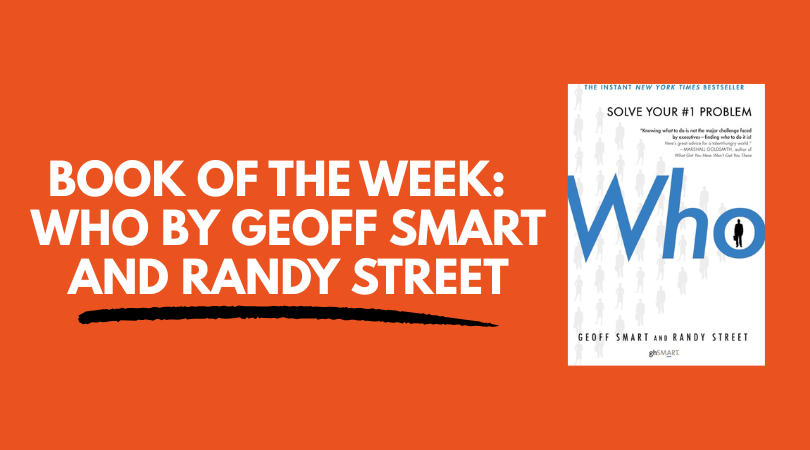
My Book of the Week Takeaway from Who by Geoff Smart and Randy Street
Have you ever hired someone and, a few months later, asked yourself, “How in the world did I miss that?”
I have.
If you have ever owned a business, managed a team, promoted someone, or trusted a person with an important role, you have probably been there too. The interview went well. The person said the right things. They seemed sharp, likable, capable, and ready. Then reality showed up. The habits were not there. The ownership was missing. The attitude was off. The follow-through was weak. And suddenly the person you thought you hired was not the person showing up every day.
That is why Who by Geoff Smart and Randy Street is such a powerful book. It is not flashy. It is not full of rah-rah motivation. It does not try to make hiring sound easy. What it does is even better. It gives leaders a practical way to think about the most important decision they make in business.
Who gets on the team?
That question matters more than most people realize. In business, we talk a lot about strategy, marketing, sales, systems, branding, software, and growth. All of those things matter. I love systems. I love sales. I love marketing. I love building the machine. But at the end of the day, every system is only as strong as the people operating it.
The wrong person can break a good system. The right person can elevate an average one.
At Window Ninjas, I have learned this lesson through experience. Some of it was exciting. Some of it was expensive. Some of it was painful. And some of it made me realize that hiring is not something you do when you have time. Hiring is leadership.
Hope Is Not a Hiring Strategy
When I first got into the window cleaning business, I was not thinking about scorecards, structured interviews, or hiring systems. I was thinking about survival. I had a squeegee, a work ethic, and a desire to build something better for my life.
Like a lot of entrepreneurs, I believed that if I could find people who were willing to work hard, I could teach them the rest. And to some degree, I still believe that. Skills can be taught. Processes can be trained. Scripts can be practiced. A person can learn how to clean windows, pressure wash a house, answer the phone, follow up with a customer, or run a route.
But there are some things that are much harder to teach.
You cannot easily teach hunger to someone who does not want to move. You cannot teach ownership to someone who blames everyone else. You cannot teach pride to someone who is just trying to get through the day doing as little as possible. And you cannot build a great company with people who do not care about the details.
That is where many hiring mistakes begin. We hire because we are desperate. The phones are ringing. The schedule is full. The call center needs help. The service manager needs another technician. The sales team is stretched. The business is growing, and we just need someone in the seat.
So we start hoping.
We hope they will show up. We hope they will figure it out. We hope they will care. We hope they will become the person we need them to be.
But hope is not a hiring strategy.
Hope is fine when your team is down two touchdowns and there are three minutes left in the game. Hope is not fine when you are handing someone the keys to your customers, your brand, your culture, and your reputation.
That was one of my biggest takeaways from Who. The book forces you to slow down. It reminds you that hiring should not be a guessing game. You need a process. You need clarity. You need to know exactly what success looks like before you bring someone into the company.
The Cost of the Wrong Person Is Bigger Than Payroll
One of the biggest mistakes business owners make is thinking the cost of a bad hire is just the paycheck.
It is not.
The wrong person costs you in ways that do not always show up neatly on a profit and loss statement. They cost you time. They cost you momentum. They cost you customer experience. They cost you culture. They create drag inside the organization.
And here is the part that really matters. A bad hire does not just frustrate the owner or the manager. A bad hire affects the good people first.
Your best employees feel it when someone is not pulling their weight. They feel it when standards drop. They feel it when excuses are tolerated. They feel it when a person with a poor attitude is allowed to stay too long. They start wondering why they are working so hard while someone else is dragging the wagon with both feet on the ground.
That is dangerous.
At Window Ninjas, we work hard to deliver a real customer experience. We are not just cleaning windows. We are showing up at people’s homes, communicating professionally, protecting their property, doing the work right, and leaving them with a reason to call us again. That takes people who care.
In our call center, the person answering the phone is not just answering a call. They are often the first impression of the entire company. In the field, the technician is not just doing a task. They are representing the brand at the customer’s home. In management, the leader is not just checking boxes. They are setting the tone for the team.
So when we hire, we are not just filling a position. We are protecting the brand.
That is why the question “who” is so important.
Who are we trusting with the customer?
Who are we trusting with the team?
Who are we trusting to carry the standard when nobody is standing over their shoulder?
Those questions matter.
The Interview Should Reveal the Pattern
What I appreciated about Who is that it does not make hiring about cute interview questions or gut feelings. It teaches you to look for patterns.
That is important because almost everyone can look good in an interview for thirty or forty-five minutes. People know how to dress up their answers. They know how to say they are hardworking, dependable, coachable, and excited for the opportunity. Nobody walks into an interview and says, “Just so you know, I am probably going to be late twice a week and complain when you hold me accountable.”
That would be helpful, but it usually does not happen.
So the leader has to learn how to dig deeper.
What has this person actually done?
What were they hired to accomplish in previous roles?
How did they perform?
Why did they leave?
What would their previous boss say about them?
Where did they struggle?
What patterns keep showing up?
That is where the truth lives.
This connected strongly with another book I have read and like a lot, Hiring for Attitude by Mark Murphy. That book focuses heavily on attitude, coachability, and whether the person fits the culture. Who gives you a structure for understanding the person’s track record. Together, those ideas are powerful.
Because skills matter, but patterns matter more.
A person’s past behavior does not tell you everything, but it tells you a lot. If someone has a pattern of ownership, growth, responsibility, and results, that is worth paying attention to. If someone has a pattern of excuses, short stays, blaming managers, blaming companies, and never quite being the problem, that is worth paying attention to as well.
Leaders get in trouble when they ignore the pattern because they like the personality.
I have done that before.
You like the person. They seem sharp. You see potential. You start selling yourself on what they could become instead of paying attention to what their history is telling you.
That does not mean people cannot grow. Of course they can. I believe in growth. I believe in coaching. I believe in giving people opportunity. But belief should not make us blind.
A good hiring process helps protect us from our own wishful thinking.
Sometimes Leaders Push Because They See Something
One of the thoughts this book brought up for me is that hiring is not only important for leaders. It is also important for employees and people trying to grow in their careers.
If you are working inside a company and your leader is pushing you, challenging you, holding you accountable, or asking more from you, you may think they are just being hard on you. Sometimes that is true. Leaders are human. We do not always get it right.
But sometimes a leader pushes because they see something in you.
That is an important idea.
I know there have been people at Window Ninjas who I pushed because I saw potential in them. I saw a future crew leader. I saw a future manager. I saw someone who could become great with the right habits, the right attitude, and the right level of responsibility.
The hard part is that people do not always see in themselves what a leader sees in them.
And growth can feel uncomfortable. Accountability can feel personal. Coaching can feel like criticism if you are not ready to receive it. But a great leader is not trying to make people uncomfortable for sport. A great leader is trying to pull something better out of them.
That is why this book made me think about both sides of the relationship.
Leaders need to hire better, define success more clearly, and coach with intention. Employees need to understand that opportunity usually comes wrapped in responsibility. If someone is trying to help you grow, do not run from that. Lean into it.
Ask yourself, “What do they see in me that I may not be fully using yet?”
That question can change a career.
Define Winning Before You Hire
One of the strongest lessons from Who is that leaders must define what success looks like before they hire.
That sounds obvious, but a lot of companies skip it.
They say, “We need a sales manager.”
Okay. What does that actually mean?
Does the sales manager need to improve booking rates? Train call center agents? Run daily huddles? Build a scorecard? Hold the team accountable? Increase outbound follow-up? Work with dispatch? Improve customer communication? Recruit new reps? Protect the culture? Drive revenue?
If the leader cannot clearly define the win, how can the candidate possibly deliver it?
This is something I have had to continue improving at Window Ninjas. As the company grows, clarity becomes more important. When you are small, people can survive on hustle and constant communication. But as the organization grows, you need roles, responsibilities, scorecards, expectations, and systems.
You cannot just tell people to “do a good job” and then get frustrated when their definition of good is different from yours.
That is not leadership.
If we want people to win, we have to define the game.
This applies to salespeople, service technicians, dispatchers, managers, franchisees, and leaders. People need to know what matters most. They need to know how they will be measured. They need to know where they have freedom and where they must follow the system.
A great person in the wrong seat can struggle. A good person with unclear expectations can become frustrated. A weak person in an important seat can create chaos.
That is why hiring and role clarity go hand in hand.
My Golden Squeegee Rating
I give Who by Geoff Smart and Randy Street 4.7 out of 5 Golden Squeegees.

This is a strong business book because it gives leaders a real process. It does not make hiring mystical. It does not tell you to trust your gut and hope for the best. It gives you a way to think, prepare, interview, evaluate, and make better decisions.
My biggest takeaway is simple.
Hiring is not about finding people. It is about finding the right people for the right role at the right time with the right expectations.
That matters whether you own a business, manage a department, lead a sales team, run a service crew, or are trying to grow in your own career.
For business owners, this book will make you slow down and take hiring more seriously.
For managers, it will help you think more clearly about who belongs on your team.
For employees, it may help you understand that when a leader challenges you, they may not be trying to tear you down. They may be trying to pull something out of you that you have not fully stepped into yet.
That is leadership at its best.
Finding people matters.
Developing people matters.
Believing in people matters.
But choosing the right people first makes everything else easier.
Because when the right person gets into the right seat, with clear expectations and strong leadership, something powerful happens. They do more than complete tasks. They grow. They contribute. They build confidence. They raise the standard around them.
And sometimes they become the person the leader saw before they could see it themselves.
That is what Who reminded me.
The future of your business, your team, and maybe even your career may come down to one simple question.
Who?
Keep Shining.
