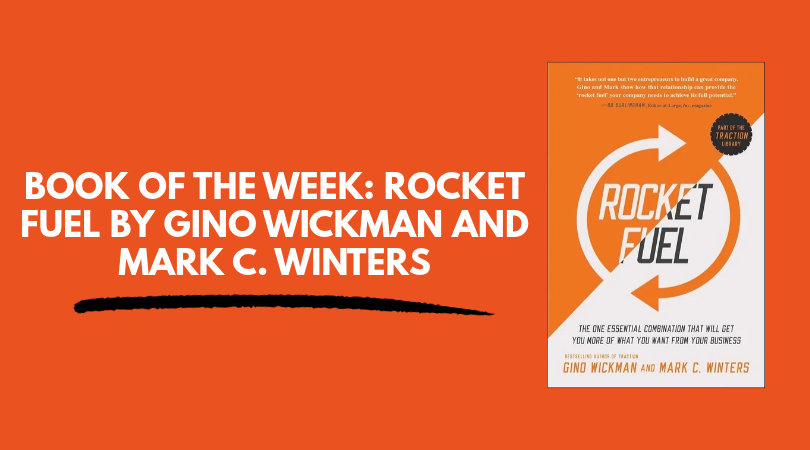
Book of the Week: Rocket Fuel by Gino Wickman and Mark C. Winters
Have you ever had six brilliant ideas before your second cup of coffee and zero idea who was going to make any of them happen?
Yeah. Me too. Every single day.
I am the guy who walks into the office on a Monday morning and says, “What if we…” and you can actually hear my team brace for impact. Chairs creak. Somebody quietly closes a laptop. One of my managers starts doing that slow nod that really means, “Here we go again.”
That is what it is like to be a Visionary. And this week’s book explained me to myself better than I could have done in thirty years of trying.
How This Book Found Me
Rocket Fuel came to me the way the best books usually do. Through people.
A friend of mine brought it up a few weeks ago. Then, almost like the universe was nudging me, another associate mentioned it too. When two people you respect point at the same book, you pay attention. So I picked it up.
And as soon as I cracked it open, I realized I already knew the author. Gino Wickman is the guy behind Traction and the Entrepreneurial Operating System, better known as EOS. He has a handful of books out, and every one of them is packed with real, usable stuff. He is a solid business mentor in print. No fluff. No fairy dust. Just tools.
So I did what I do. I absorbed it.
The Big Idea: Two Seats, One Rocket
There are a ton of nuggets in this book. Gino and his co-author Mark C. Winters could have split it into five books and still had leftovers. But one idea landed on me like a ladder on a gutter.
Every great company has two very different people at the top.
The Visionary. The idea machine. The big thinker. The person who sees where the company could be in ten years and gets fired up about it. Great at relationships, great at solving the big problems, great at creating energy.
The Integrator. The steady hand on the wheel. The person who takes the vision, organizes it, assigns it, holds people accountable, and makes it actually happen. They harmonize the team and keep the trains running on time.
Put those two together the right way and you get rocket fuel. Get it wrong and you get a very expensive firework.
Here is what I love about how Gino frames it. Neither seat is better than the other. A Visionary without an Integrator is a guy with a notebook full of dreams and a business that never grows. An Integrator without a Visionary is a perfectly organized machine driving in circles. You need both. Period.
Reading that, I literally put the book down and laughed. Because that is my life. That is my company.
Confessions of “That Guy”
Let me be honest with you. I am that guy.
I get ideas all day long. In the shower. In the truck. At 4 a.m. in the middle of meditation when I am supposed to be clearing my mind. My brain is basically a popcorn machine with no off switch.
And the details? I leave them to others. Gladly. Joyfully. Gratefully.
Now, if you are a Visionary, you know this can drive people bonkers. Imagine working for somebody who hands you a brand new initiative on Tuesday, two more on Wednesday, and then on Thursday asks, “Hey, how is that thing from Tuesday going?”
That is what my team signed up for. God bless them.
But here is where it gets good. Over the years, my team built something I now consider one of the most valuable parts of Window Ninjas. A check and balance system.
When I throw an idea out there, my implementors do not just run off a cliff with it. They test it. They analyze it. They run the numbers. And then one of two things happens.
Either they come back and say, “Gabe, the red flags are popping up. Here is why this one will not work right now.”
Or they come back and say, “Boss, this is a home run.”
That system keeps me grounded. It keeps the company from chasing every shiny object I toss into the room. And most importantly, it makes sure the right visions get implemented. Not all of them. The right ones.
If you are a Visionary reading this, ask yourself something. Who in your company is allowed to tell you no? If the answer is nobody, you do not have a team. You have an audience.
Handing Over the Keys
Now let me take you back many moons ago.
The first time I brought in a manager, it was hard. Really hard. I had built this thing from the ground up. I started cleaning windows at 17 with no car and no money. Every customer, every route, every squeegee stroke had my fingerprints on it.
And now I was supposed to just hand somebody the keys and walk away?
I could not keep my mind off what they were doing. How is it going? Did they call that customer back? Are they doing it the way I would do it? I was like a parent watching their teenager drive for the first time. Hands gripping the dashboard, stomping on a brake pedal that is not there.
And I will be straight with you. The first couple of managers I hired were not the best. I needed a learning curve, and I paid tuition for it. Some lessons cost money. Some cost time. Some cost a little bit of pride.
But then I found the right person.
She was organized. She held people accountable. And she was devoted. Not “clock in, clock out” devoted. All in.
That one hire changed everything. Because she did not just manage. She developed other leaders. And together we built the management system that Window Ninjas still runs on today.
That is the thing nobody tells you about hiring the right leader. It is not one hire. It is a chain reaction.
My Rocket Fuel Crew Today
Fast forward to today. I am surrounded by integrators who make me look a lot smarter than I am.
My sales manager is an integrator. And he is the best.
My CFO, Melisa, is an integrator. She is also my wife. And she is the best. (She will be reading this, so I am contractually obligated to say that. But it also happens to be true.)
My COO is an integrator and a great leader.
Gino talks about one Integrator in the seat next to the Visionary, and I get why. But in our world, I have leaders in their lanes who each bring that integrator muscle to their side of the business. Each one takes the vision and turns it into reality in their own department. That is my version of rocket fuel, and it is working.
How I Lead Now: Vision, Then Step Away
So what does a typical week look like for a Visionary who has learned his lesson?
I follow up. I listen. I add my advice and my input. I paint a picture of what I would like to see happen.
And then I step away and let them do their thing.
That last part is the hardest part, and it is the most important part. Because when you hire great leaders and then micromanage them, you are paying for a Ferrari and pushing it down the road.
When I step away, one of three things comes back to me.
“Done.” Beautiful. My favorite word in the English language.
“Done, but we tweaked it a bit because of A, B, and C.” Even better. That means they thought harder about it than I did, and the result is going to work perfectly.
“Houston, we have a problem. Here is the issue, and here is the alternative path we suggest.”
And that third one? That is where my job really kicks in. I listen. I weigh it. And I make the decision.
That is the Visionary’s real job. Not doing the work. Not hovering over the work. Setting the direction, trusting the team, and making the call when it counts.
The Lesson I Learned the Hard Way
Long before I ever read Rocket Fuel, my business was teaching me this lesson the hard way.
Visionaries need integrators. We just are not that great at the details. And that is okay.
It all goes back to building a team. You cannot be a team of one. I tried. For years. You can wash a lot of windows as a team of one. But you cannot build a franchise system across five states as a team of one.
If you want to build something big, you need experts in their field. People who are better than you at the things you are worst at. People who will push back, test your ideas, and then run through walls to make the good ones happen.
The best thing I ever did for my business was admit what I am not.
So let me ask you. What are you still holding onto that somebody else could do better? What is it costing you to keep it?
Would I Argue With Gino?
Not a chance.
We might debate a bit over coffee. I might ask him for more clarification here and there, because that is how I handle everyone. But at the end of the day, Gino and I are on the same page. He just wrote it down better than I could.
Who Needs This Book?
Any entrepreneur. Any leader of an organization. Period.
If you are a Visionary, this book will help you understand why your team gets that look on their face when you start a sentence with “What if.” And it will show you how to find the person who can take your crazy ideas and turn them into real results.
If you are an Integrator, this book will help you understand the wild-eyed dreamer you work for. And it will show you how valuable you really are.
And if you are a solo operator still doing everything yourself? Read it twice. Then go find your rocket fuel.
The Golden Squeegee Rating

5.0 Golden Squeegees.
This book is a must read for every entrepreneur. It gave me words for something I lived for decades, and it showed me that the partnership between a Visionary and the integrators around him is not a nice-to-have. It is the engine. Gino does not just explain the problem. He hands you the tools to fix it. That is a perfect score in my book, and in my business.
Follow my journey at gabesalinas.com, subscribe on Substack, and connect with me on social media.
Keep Shining!
Gabe Salinas The World’s Greatest Window Cleaner
