What if one of the most powerful business tools in your life is not a CRM, a marketing funnel, or some overpriced mastermind… but a pen?
And what if the reason some people keep “hoping” their way through life while others actually build the life they want is because one group is wishing, and the other group is writing?
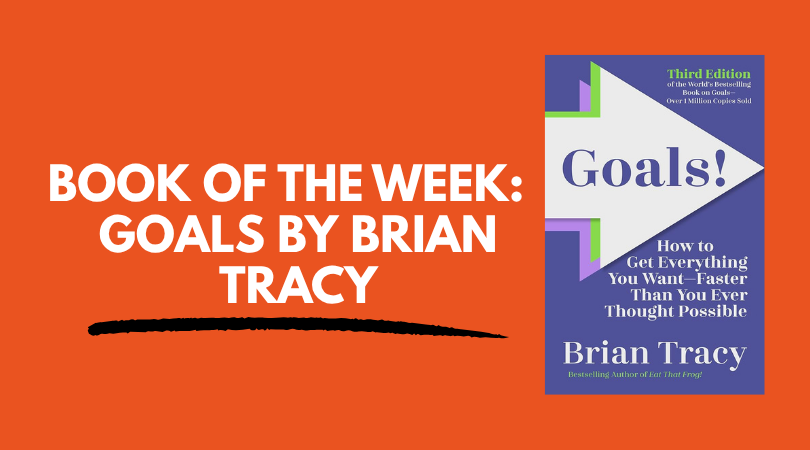
This week’s Book of the Week is Goals by Brian Tracy, and I’ve got to tell you, this one was a goodie. Not because it told me something I had never heard before, but because it took something I already believed in and explained it in a way that made me tighten the bolts. I already write my goals down every day. I already believe in vision. I already believe that if you do not tell your life where to go, it will gladly wander off into the woods like a drunk squirrel.
What Brian Tracy did in this book was give structure to that belief. He explained why writing your goals down works, why putting a date on them matters, and why writing them as if they have already happened can actually change the way you think, act, and move. That is where this book delivers. It is not fluff. It is not hype. It is practical psychology with a kick in the pants.
This Book Did Not Teach Me to Dream, It Taught Me to Aim
A lot of people say they have goals.
No they don’t.
They have preferences.
They have ideas.
They have things they would “love to do one day.”
They have a vision board and a weak pulse.
A goal is different.
A real goal has teeth.
Brian Tracy does a great job making that clear. He teaches that goals need to be written, specific, dated, and stated in a way that leaves no wiggle room. Not “I want to make more money.” Not “I hope my business grows.” That is cute. That is also useless.
A real goal sounds more like this:
“I earn $50,000 per month by December 31, 2027.”
Now we are talking.
That kind of language does something to you. It forces you to think differently. It forces you to act differently. It makes you stop living in vague-ville and start moving with intent.
That is one of the biggest reasons I liked this book. Brian Tracy does not just tell you to have goals. He shows you how to write them in a way that gives your brain a target.
And last time I checked, targets work a whole lot better than wishes.
Writing Goals Like They Already Happened
This was one of the biggest takeaways for me.
Brian Tracy talks about writing your goals in the present tense, as if they have already been achieved. At first, some people may hear that and think it sounds a little woo-woo. Like you are hugging crystals in a field somewhere and asking the universe to send you a Lamborghini.
That is not what this is.
This is about identity.
This is about belief.
This is about mental programming.
When you write, “I own and operate 60 Window Ninjas locations by December 31, 2036,” your mind starts organizing around that. When you write, “My company produces $30 million in annual service revenue by December 31, 2031,” you are no longer casually daydreaming. You are giving your subconscious a job description.
That is where this book gets powerful.
It teaches you that the words you use matter. The way you write matters. The certainty matters.
Most people write goals like they are trying not to offend failure.
“I’d like to…”
“I want to…”
“It would be nice if…”
Come on.
That is not how leaders talk.
That is not how owners think.
That is not how people build real lives.
This book pushes you to write with clarity and certainty. And whether you call it mindset, manifestation, psychology, or discipline, I can tell you from my own life that there is something real happening when you repeatedly write down the future you are committed to creating.
The Date Changes Everything
Here is where Brian Tracy really earns his money in this book.
He makes it very clear that the date is not decoration.
The date is the deal.
Without a date, a goal is just a motivational poster with better grammar.
The minute you attach a deadline, everything changes. Now the goal has pressure. Now it has urgency. Now it has accountability. Now it is not living in fantasy land wearing flip-flops and talking about “someday.”
Now it has a clock.
And that matters because a clock forces action.
When you write a goal with a date, your brain starts asking better questions:
What needs to happen this month?
What needs to happen this week?
Who do I need to become?
What do I need to stop doing?
What distractions need to get kicked out of the truck?
That is where progress starts. Not with hype. Not with vibes. With clarity.
Dan Martell talks a lot about designing your life and buying back your time through intentional decisions. This book fits right into that kind of thinking. Because if your goals are unclear, your calendar will be unclear. If your targets are fuzzy, your actions will be fuzzy. And fuzzy actions produce fuzzy results.
That is a scientific term, by the way.
Why This Book Hit Me Personally
What I appreciated about Goals is that it did not make me feel like I had been doing it wrong. It made me realize I had been doing something right, but I could do it better.
That is a big difference.
I have already seen the power of writing goals down in my own life. I have been doing it for years. I have watched things that started as words on paper become real. I have watched vision become action, and action become reality. So when Brian Tracy started explaining the psychology behind it, I found myself nodding like, “Yep, that tracks.”
He simply gave better explanation to something I was already living.

And I love books like that.
The best books do not always teach you something brand new. Sometimes they validate what you know, sharpen what you do, and challenge you to raise your standard. That is what this book did for me.
It made me more intentional about how I write my goals.
It made me pay more attention to the language.
It made me focus more on dates.
It made me think harder about certainty.
That is useful.
What I Did Not Love
Now let’s be fair. Why not higher?
Because Brian Tracy is smart, but this is not what I would call an easy, breezy read. There were times I had to go back and reread sections just to really lock in what he was saying. That is not necessarily a bad thing, but I do think some readers will find it a little annoying.
This is not one of those books that glides.
It makes you work a little.
For me, that was fine because the content was strong. But from a readability standpoint, I think it could have been smoother. There is a difference between deep and clunky, and this book rides that line a little bit in places.
Still, I would rather read a book with substance that makes me reread a paragraph than read some soft, fluffy nonsense that sounds good on Instagram and changes absolutely nothing in real life.
So no, it was not the easiest read.
But yes, it was worth reading.
The Real Value of This Book
The real value of Goals is not in finishing it.
The real value is in changing what you do after you finish it.
This is a book that should make you stop and grab a notebook. It should make you rewrite your goals. It should make you ask whether you have actually defined your future clearly enough to deserve it.
Because let’s be honest, a lot of people say they want more money, more freedom, more growth, more peace, more success.
Cool.
What does that mean?
How much?
By when?
Written how?
Read how often?
What is the plan?
That is where Brian Tracy brings real value. He teaches that your goals should not be random thoughts floating around your skull like loose change in a cup holder. They should be written instructions. Clear. Directed. Repeatable.
That is when they start becoming real.
My Takeaway
If you are already writing goals down, this book will help you do it better.
If you are not writing goals down, this book might be the wake-up call you need.
And if you have been saying you want a better life, a bigger business, more money, more impact, or more freedom, but you have not clearly written it down with a date and in the present tense, then you may not have a goal at all.
You may just have a pretty little wish wearing dress shoes.
Goals by Brian Tracy is educational, practical, and loaded with insight. It is not always the smoothest read, but it absolutely delivers value. It helped me understand more deeply why writing goals works, why dates matter, and why language has power. More importantly, it gave me immediate things I could apply to my daily habits.
That is what I want from a book.
Not just inspiration. Application.
My rating is 4 out of 5 golden squeegees.

And my advice is simple: pick up the book, grab a pen, and stop writing your future like you are asking permission from it. Write it like you mean it. Write it like it is happening. Write it with a date. Then go do the work required to make the paper tell the truth.
That is where things get fun.
Keep Shining.
