
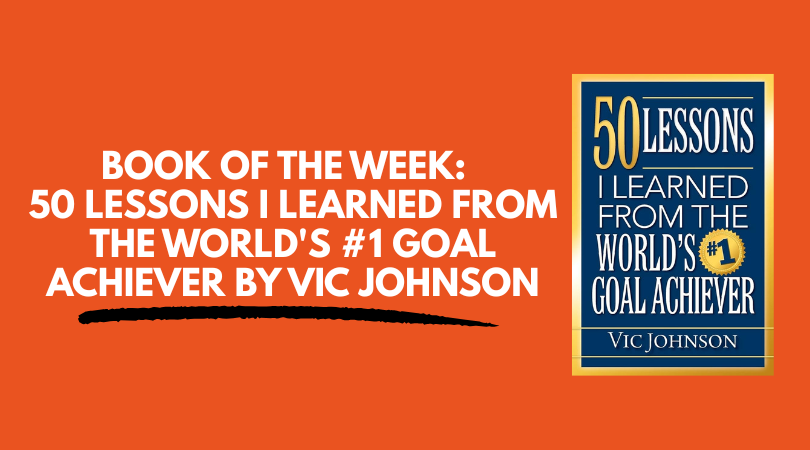
I experienced 50 Lessons I Learned From the World’s #1 Goal Achiever by Vic Johnson in a way that felt fitting for the message it delivers. Part of it came through Audible, part of it came from sitting down and reading the physical book. That mix mattered, because this is not a book you just “get through.” It is a book you reflect on.
What stood out immediately was not some revolutionary idea I had never heard before. It was something much more powerful. This book reinforced what I already knew, while at the same time exposing the areas where I was falling short. That combination forces you to pay attention. It forces you to think.
If I had to sum it up in one sentence, it would be this: success is a byproduct of consistency. Not talent, not luck, not even intelligence. Consistency. And on the other side of that, procrastination is not just laziness. It is unfinished business that sits in your mind, quietly creating weight that you carry whether you acknowledge it or not.
The Power of Thought, Environment, and Ownership
Several lessons in this book hit harder than others, not because they were new, but because they were true.
One of the most important ideas is that you become what you think. That sounds simple, but it is one of the most dangerous forces in your life. If you tell yourself you can do something, you begin to act accordingly. If you tell yourself you cannot, you never even give yourself a chance. Self-doubt is not just a feeling. It is a decision that limits everything that follows.
Right alongside that is the reality that you become who you surround yourself with. I see this play out every day inside Window Ninjas. The people who push themselves, who take ownership, who want more out of life, tend to find each other. The ones who complain, who look for shortcuts, who avoid responsibility, tend to do the same. Average is rarely accidental. It is usually environmental.
Then there is ownership. Taking responsibility for everything in your life is one of the hardest things to do, and one of the most important. Blame is easy. There is always something or someone you can point to. Ownership requires you to look at your results and say, “That is on me.” It is uncomfortable, but it is also where growth begins. In my own life and business, this is an area that I continue to work on, because the standard is high and the work is never finished.
The Hidden Weight of Unfinished Work
One concept from this book stood out in a way that is hard to ignore, and that is the importance of finishing what you start. The reason goes deeper than productivity. It is psychological.
Your brain knows when something is incomplete.
Think about something as simple as taking a load of clean socks out of the dryer. You know they should be folded, matched, and put away properly. Instead, you throw the pile into the drawer and move on. Every time you open that drawer, you see the mess. Your brain registers it. There is a small weight attached to that decision.
Now multiply that by every unfinished task in your life. Projects that never got completed. Calls that never got returned. Goals that were written down but never pursued. Each one adds a small amount of pressure, and over time, it builds into something much heavier.
Finishing what you start is not just about getting things done. It is about removing that weight so you can think clearly, act decisively, and move forward without friction.
A Mirror, Not a Manual
What makes this book different is that it does not try to overwhelm you with complexity. It serves as a mirror. Most of the lessons are things you already know at some level. The difference is that the book forces you to confront whether you are actually living them.
In my case, I found that I was doing many of these things well. At the same time, there were clear areas where I needed to improve. That is what makes this book valuable. It is not just instructional. It is reflective. It gives you insight into why you feel the way you do, whether that feeling is positive or negative.
How These Lessons Show Up in Business
Inside Window Ninjas, these principles are not theoretical. They show up in real time, through real people, every single day. I can look at a team member’s habits and almost directly connect them to the outcomes they are experiencing.
The individuals who follow through consistently tend to win. The ones who take responsibility grow. The ones who stay disciplined, even when it is repetitive or boring, rise over time. On the other hand, those who avoid these fundamentals tend to stay exactly where they are.
There is a direct connection between behavior and results. This book simply makes that connection impossible to ignore.
Goals Without Action Are Just Ideas
One of the biggest mistakes people make is believing that writing down goals is enough. It is not.
Most people do not define their goals clearly. They do not revisit them daily. And most importantly, they do not take consistent action toward them. As a result, nothing changes.
In my own life, I have seen the opposite play out. I wanted to become a millionaire, and I achieved that. I wanted to become a pilot, and I did. I wanted to own a business, and today I run one. None of those outcomes were accidental. They were the result of writing goals down, believing they were possible, and working toward them over time.
The process is not complicated, but it does require commitment.
Reinvention Through Consistency
If someone were to take these 50 lessons seriously and apply them over the course of a year, the result would not just be improved performance. It would be personal reinvention.
There would be less stress, because fewer things would be left unfinished. There would be more clarity, because goals would be defined and reviewed regularly. There would be more confidence, because action creates momentum, and momentum creates belief.
Consistency is not exciting, but it is effective. That is the trade-off most people struggle with.
My Approach and Your Next Step
Every morning, I write my goals down as if they have already been achieved. This simple habit keeps me focused and aligned with what I want to accomplish. It is not complicated, but it works because it is consistent.
If you are looking for a place to start, this book provides a clear path. My recommendation is simple. Do not just read it. Use it. Treat it as a 50-day reset. Take one lesson each day, apply it, and move on to the next.
The impact will compound faster than you expect.
Final Thoughts
I give this book five out of five golden squeegees. It is easy to read, highly relatable, and surprisingly deep. At the same time, it can be challenging to follow if you are not willing to stay disciplined and consistent.

But if you are, the reward is significant. You will not just understand what it takes to succeed. You will begin to live it.
Keep Shining.
