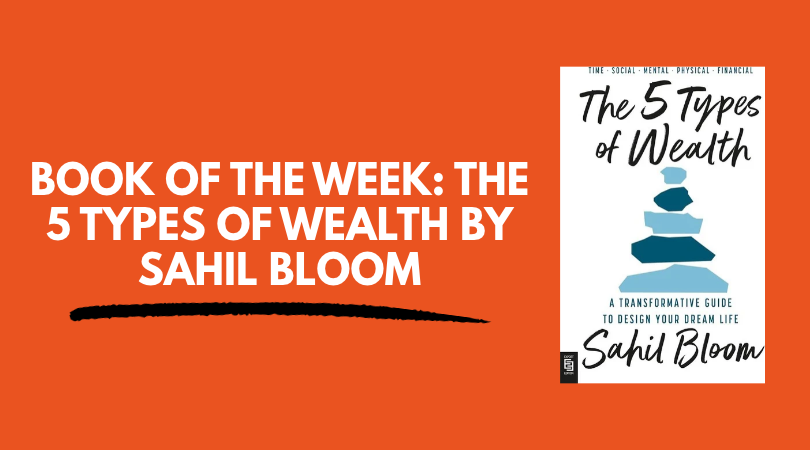
Book of the Week: The 5 Types of Wealth by Sahil Bloom
I didn’t go looking for this book. Audible threw it at me while I was packing for a week of travel and family. Highly rated. Short. Easy listening for the road.
What I got was a book I’d already read a dozen times. Just never under this title.
Twenty minutes in, I had one thought.
This is the book Kamala Harris read right before she hit the campaign trail and started talking about the passage of time.
I’m serious. The first half of this book goes on and on and on about time. The passage of time. The time of passage. How it all flows and goes together. And I’m sitting there thinking, Kamala read this. She absolutely read this. And she must have stopped short right at the midway point, because that’s exactly where all the passage of time stuff finally slows down and the book gets into the good stuff.
She should have kept going. I did.
The Part That Got Me
Here’s where all the time talk lands. Bloom stops being philosophical and does the math.
How many more times are you going to see someone before you die? Or before they do?
Not in theory. Count it. If you see your parents twice a year and they’ve got twenty good years left, that’s forty visits. Forty. That’s it.
Now think about your kids. Your best friend from high school. The buddy you keep saying you’ll call.
Then he tells the story of a young couple. Small kids at home. Another baby on the way. And she gets diagnosed with cancer.
Just like that, the math isn’t a thought exercise anymore. Every one of those numbers you thought was big just got a whole lot smaller.
That will open anyone’s eyes. It makes you think. (I wrote about this same idea in How Much Time Do You Have? and it still gets me.)
The idea isn’t new. But the way he sets it up, then hits you with that story, is worth the price of the book by itself.
Other People’s Ideas, One Framework
By the time I hit the last chapter, I’d figured out what this book really is. If you’ve been reading business and personal development books for the last few years, you’ve already read most of it.
Steve Jobs. Elon Musk. Warren Buffett. Peter Attia’s Outlive. James Clear’s Atomic Habits. Morgan Housel’s The Psychology of Money. Carol Dweck’s Mindset. Tim Ferriss. The Harvard happiness study. I could keep going.
Bloom takes bits and pieces from all of them and sorts them into five buckets: Time, Social, Mental, Physical, and Financial wealth.
That’s the whole book. Other people’s ideas, organized into one framework.
Is that a knock? Kind of. There’s almost nothing original in here. But there’s a reason I finished it.
Where I Stand on the Five
Bloom has a quiz in the book to score yourself. I skipped the quiz and just ranked them honestly, best to worst:
- Physical
- Time
- Financial
- Mental
- Social
Physical at the top doesn’t surprise me. Time and Financial are the result of years of building something that doesn’t need me in the room every day.
Social at the bottom? That one stings.
And here’s the kicker. The part of the book that hit me hardest, the math on how many more times you’ll see the people you love, is filed under time. But it’s really about people. The book found my weakest spot and poked it.
That’s probably the real reason I’m giving it the extra half star.
Who Should Read The 5 Types of Wealth?
Not everybody.
If you’ve already read the classics, this is a refresher course. You’ll nod along. You’ll recognize every story. You’ll finish it a little faster than you expected.
But if you’re into health and fitness, longevity, getting organized, and making better use of your time, and you haven’t read the books Bloom pulls from? This is a shortcut. It’s the Cliff Notes to about 90% of what I’ve read over the past three years. You’ll walk away with a reading list for the next two to three years and a head start on every one of them.
Here’s what it really means if this book feels like a rerun to you. It means you’ve done the reading most people haven’t. That’s not nothing. That’s the work.
My The 5 Types of Wealth Review: 3.5 Stars

It loses points for originality. It earns them back for organization and one story that’ll make you call your mom.
Pick it up if you want the map. Skip it if you’ve already walked the territory.
Want the Original Sources?
Here are the books Bloom leans on hardest. If you want the meat and potatoes instead of the summary, start here:
- The Psychology of Money by Morgan Housel
- Outlive by Peter Attia
- Atomic Habits by James Clear
- The Good Life by Robert Waldinger and Marc Schulz
- Mindset by Carol Dweck
- The 4-Hour Workweek by Tim Ferriss
- Quiet by Susan Cain
Reading something good this week? Or wondering what a guy who’s read most of the business section is reading next? Check out my last Book of the Week, then reach out. I’m always up for a conversation.
Gabe Salinas is the founder of Window Ninjas Franchising and, by his own count, the world’s greatest window cleaner. Every week he shares a Book of the Week review, from The Fountainhead to The 5 Types of Wealth, with his honest take on what’s worth your time.
