
What if everything you believe about why you are unhappy is a lie you tell yourself on purpose?
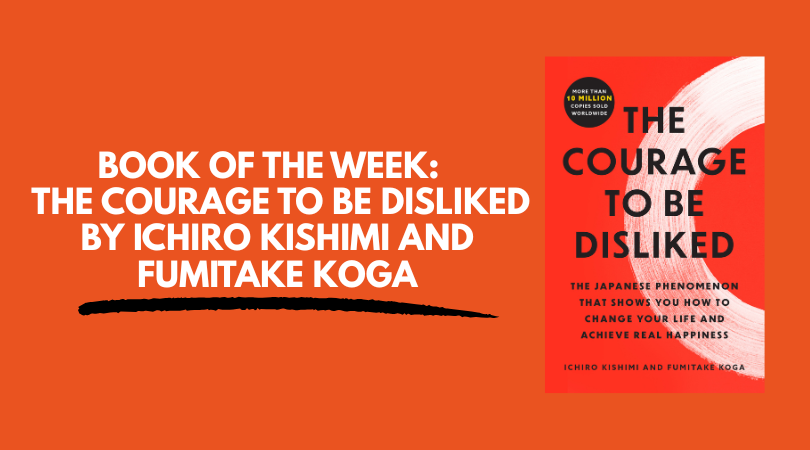
Read that again. That right there is the eye opener waiting for you inside this week’s book, The Courage To Be Disliked by Ichiro Kishimi and Fumitake Koga. This one got under my skin in the best way. It changed how I see people, how I handle my relationships, and why I make the calls I make.
So how did this book end up in my hands? Funny story. I had just wrapped How To: $10M by William Brown, and I was out on my morning walk with that itch every reader knows. Empty hands. Hungry brain. So I pulled up Audible to go shopping on my own wishlist. Before I could scroll, the algorithm leaned over my shoulder like a buddy at a bookstore and said, hey, you should try this one. The Courage To Be Disliked. Now Audible suggests books to me all day long, and most of them I swipe past like junk mail. This one I stopped on for one reason. A Japanese author wrote it.
Here is the thing about Japanese thinking. It does not tiptoe. It walks straight up to the biggest questions in life and stares them down without blinking. Their insight runs deep. Their passion is the real deal. And half the time they land on a truth so clean it makes a Western brain do a double take and mutter, wait, how did they get there before me? That is catnip for a curious guy. So I tapped the teaser. Sixty seconds in, I was hooked like a fish who forgot he had a mouth. Downloaded it on the spot. Then, because patience has never exactly been my superpower, I hopped on Amazon and ordered the hardcover too. Two formats of the same book. Overkill? Probably. But when something grabs me by the collar, I do not play it cool. I listened on every walk until that copy hit my mailbox two days later.
And here is the part I cannot shake. I do not think one bit of that was an accident. Some books speak to you. Sometimes life slides exactly what you need across the table at the precise moment you are sweating the problem it was written to solve. I saw the signs, and I followed them. Ever since I cracked open Jung’s Memories, Dreams and Reflections, I read the world a little differently. The static got quieter. The signal got louder. Life hands you what you need, the good stuff and the gut check stuff both, and if you have done the work to actually know yourself, you stop fumbling the gifts. You start collecting tools instead of excuses.
A Book Built Like a Conversation
First, the format, because it matters. This book is not a lecture. It is a conversation. The whole thing plays out over five nights between a Philosopher and a young man the authors call the Youth. The Youth argues. He pushes back. He calls the Philosopher’s ideas naive and impossible. He says what you are already thinking when you read this stuff.
And that is the genius of it. You are the Youth. Every lesson lands as something most of us would reject on the surface. Unhappiness is something you choose. People always choose not to change. You read those chapter titles and your first reaction is, no way. Then the Philosopher walks you through it, the Youth fights him every step, and somewhere along the way the floor moves under you.
This is not Freud. Freud looks backward. He says your past wounded you and made you who you are. This is Adler. And Adler flips that idea like a pancake that needs its backside bronzed. He says you are not shaped by your past. You are using your past. You hold onto the wound because it serves a purpose right now. That purpose is usually an excuse. It is the death of victim mentality dressed up in a calm, patient conversation. And as a guy who has zero tolerance for victim thinking, this hit me right in the chest.
The Line That Stopped Me In My Tracks
There is one lesson in this book that stopped me in my tracks. And I mean it slammed the brakes on me faster than a squirrel who looks at oncoming traffic and thinks to himself, no problem, I can beat that car to the other side. All problems are interpersonal relationship problems.
Sit with that one. The Philosopher claims every worry you carry, every anxiety, every frustration, traces back to your relationships with other people. I read the chapters under that idea and found myself pausing, putting the book down, and just thinking. Because the more I turned it over, the more I saw it everywhere. In business. In family. In the version of myself I show the world.
And it connects straight to the most dangerous trap in the book. The recognition trap. The need to be praised. Kishimi explains that Adler was hard on education by reward and punishment. He warned it creates a mistaken lifestyle, where a person thinks, if no one is going to praise me, I will not take the right action, and if no one is going to punish me, I will do the wrong thing too.
Read that and tell me you do not see it in the world today. People chasing applause. People behaving only when someone is watching. That is a prison, and most folks never realize they are locked inside it.
The Philosopher’s answer is brutal and freeing at the same time. You are not living to satisfy other people’s expectations. There is a line drawn from the teachings of Judaism that I cannot shake. If you are not living your life for yourself, then who is going to live it for you? When you spend your days chasing everyone else’s approval, you throw away who you really are. You end up living other people’s lives. That is not happiness. That is hostage negotiation.
What This Looks Like In My Life
One of the heaviest ideas in the whole book is what the Philosopher calls the separation of tasks. Here is the simple version. Your task is to live your life with integrity. What other people think about how you live it is their task, not yours. Adler says the moment you stop trying to do everybody else’s task for them, you are free. Free of a weight you were never built to carry in the first place.
I will be straight with you. The first time that idea hit my ears, the doer in me wanted to fight it. I built a company from a bucket and a squeegee. My whole life I have grabbed every task in sight. Sales, hiring, training, scrubbing glass three stories up in the cold while the coffee in the van went lukewarm. So being told that some tasks are simply not mine to carry felt almost like cheating. Then it clicked. He is not telling you to care less. He is telling you to quit picking up other people’s homework and turning it in with your name on it.
The lesson tucked inside that one is the keeper. Kishimi argues you can change the second you decide to. Not next quarter. Not when the timing is perfect and the stars line up. Right now. The reason most people stay stuck is not the past at all. It is that staying the same is cozy, and the unknown is downright terrifying. He even drops a whole chapter titled People Always Choose Not To Change. Read that and try not to feel it poke you in the ribs. Most folks would rather cling to a familiar misery than gamble on an unfamiliar joy.
That one hit me right where I live. Twenty five years into marriage with my wife Melisa, raising my kids, building Window Ninjas brick by brick, I can tell you the work that actually moves the needle is almost never the comfortable work. It is the honest conversation I would rather dodge. It is the right call that costs me a sliver of popularity. This book handed me language for something I had felt in my gut for years but never said out loud. Growth and comfort do not carpool.
Why Every Entrepreneur Needs This
Let me bring it home for the builders reading this. Entrepreneurship is the courage to be disliked in its purest form.
You cannot build anything real while you are waiting for permission and applause. Every founder who ever mattered got doubted, criticized, and disliked on the way up. If you run your business hoping to keep every employee, every customer, and every critic happy, you will go bankrupt. Emotionally and financially. Living for praise is a slow leak in the tire of your dream.
The strongest businesses are built by people who made unpopular calls early and stuck to their standard when nobody clapped. They had a vision, they backed it, and they let the results do the talking. That is the courage this book is teaching. Not the courage to go looking for enemies. The courage to stop letting the fear of disapproval steer your ship.
The Rating
This is not a book you read once, mark off your list, and forget. This is a guide you carry through life. It dives into the deepest social and personal issues we all face. How we feel about ourselves. Why we do and say and think the way we do. And it hands you the power to choose differently.
I am giving The Courage To Be Disliked a perfect 5 out of 5 Golden Squeegees. Everyone should read it. It will deliver real insight, make you think deeper, and challenge beliefs you did not even know you were holding. But here is the catch. You have to bring the courage to be open minded and the willingness to look hard at yourself as you walk the path this book lays out. The lazy reader will reject it. The honest one will be changed by it.
So here is my challenge to you this week. Pick one relationship in your life where you have been living for someone else’s approval. Then ask the question that has been ringing in my head since I closed this book. If you are not living your life for yourself, then who is going to live it for you?
Follow my journey at gabesalinas.com, subscribe on Substack, and connect with me on social media.
Keep Shining.
Gabe Salinas
Gabe Salinas is the world’s greatest window cleaner! With three decades of experience in the industry, Gabe has the confidence and knowledge to claim his title. He is the founder and owner of Window Ninjas, a window and gutter cleaning brand he is growing through franchising, and he is on the hunt for a handful of driven owners to plant their flag with the brand this year. Gabe’s passion for cleaning is only matched by his drive to reach and inspire those who want to better themselves, and he is always ready to talk with those who want to learn.
