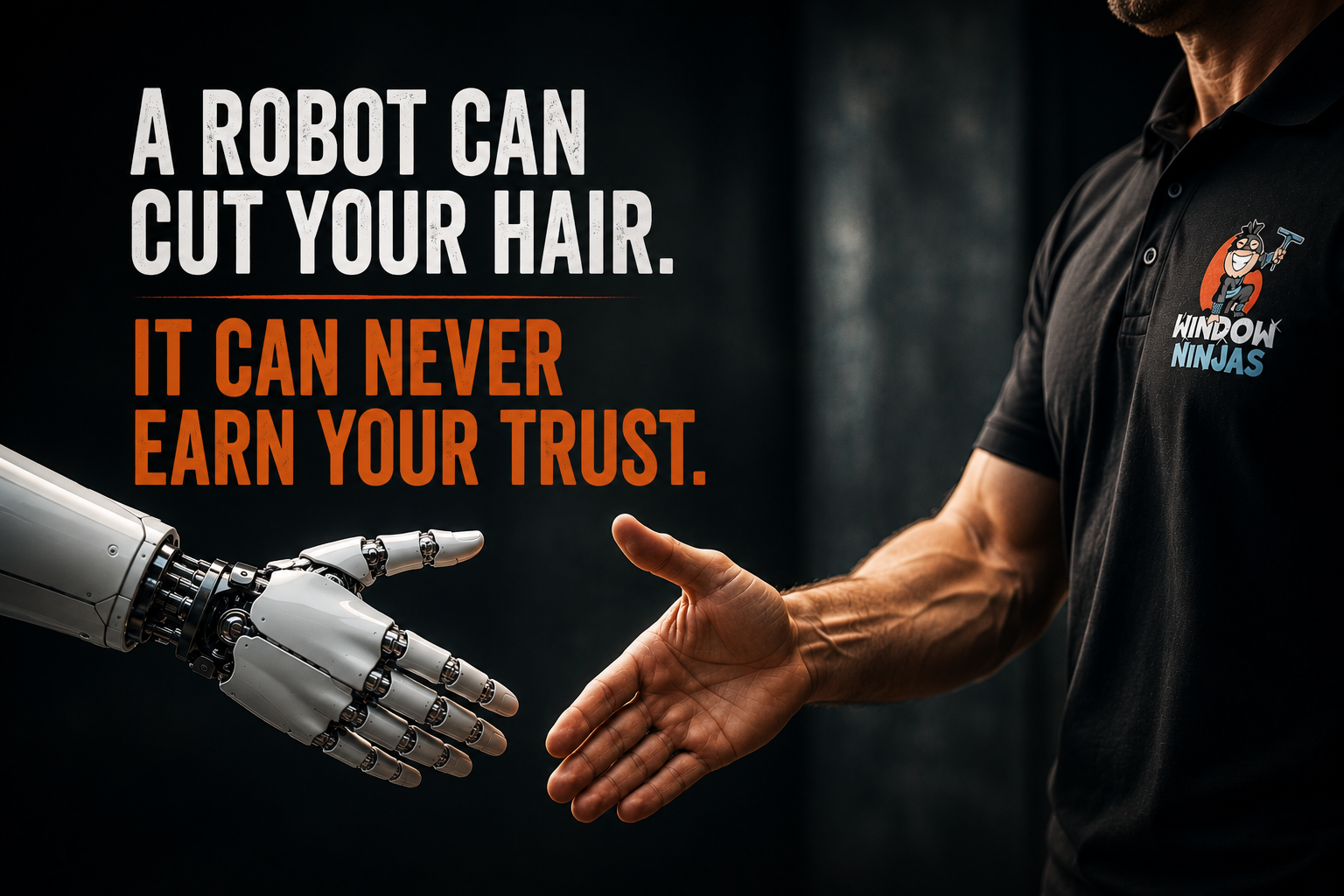
There is a version of the future, and it is closer than you think, where a robot cuts your hair for less than five dollars.
It will be fast. It will be precise. It will never run late, never call in sick, never have an off day.
And it will be completely forgettable.
Because here is what that robot will never do. It will never ask how your day is going. It will never remember that your son had a big game last weekend and ask how he played. It will never lean in with that little joke because she forgot the straw in your drink last time, and you both laughed about it, and now it is your thing.
The robot gives you a haircut. The stylist gives you a relationship.
And that, right there, is the whole conversation we need to have about what world-class service actually is.
We Have Been Confused About This for a Long Time
Ask most people what world-class service looks like and they picture money.
First class on the plane. A twenty-day tour through the south of France, the most famous wineries, the kind of dinners you talk about for the rest of your life. A five-star resort where someone learns your name before you check in.
So the average person hears the words “world-class” and quietly thinks, “that is not for me. I cannot afford that. I will never experience it”.
But here is the thing. You do not have to fly to France to feel it.
You can feel the exact same thing at a four-star restaurant in your own hometown, the one that is the talk of the town. Is it different from the twenty-day wine tour? Sure. But both are expensive in their own way, and to the person sitting at the table, both feel like a treat.
Now think about what you actually remember from that hometown dinner.
You do not remember the thread count of the napkin. You remember the waiter who told you a funny story about his love of escargot, and then tied it right back into encouraging you to try the escargot with your meal. You laughed. You trusted him. You ordered it.
That moment was not about the food. It was about the connection. Trust got built across a dinner table in about ninety seconds, and a robot cannot do that.
The luxury was never the point. The luxury was the wrapping paper. The gift inside was always the way someone made you feel.
So Why Does Yesterday’s World-Class Look So Different From Today’s
Because the floor moved.
AI and automation have changed what is normal. The baseline expectation for fast, cheap, and convenient is now sky high. You can order almost anything and have it on your porch tomorrow. You can get an answer to almost any question in three seconds. A machine can do a hundred jobs that used to require a person.
That is not a problem. That is the world we live in, and we are all going to embrace it.
But here is what most people are missing in the rush. When everything becomes automated, the human part does not become less valuable.
It becomes the entire ballgame.
When a robot can cut hair for five dollars, the stylist who knows your kids’ names is not competing on price anymore. She is competing on something the robot will never have. And she wins, because what she offers cannot be downloaded.
What Cheap Actually Costs You
I see so much of the new generation missing this point. They want cheap. They want it now.
But let me ask you something. What do you actually get for cheap?
You can buy a cheap television on Amazon. Great price. Click the button and it shows up. But now it is sitting in a box in your living room, and guess what, there is no five-star delivery and setup waiting for you.
You get to set it up yourself. You get to read the manual. You get to figure out a device that is, I promise you, smarter than a college senior. You spend your Saturday afternoon fighting with inputs and apps and a remote with forty-seven buttons.
Now picture the local guy instead.
He delivers it. He sets it up. He shows you how to use it. He shares a couple of insights you never would have found in the manual. Maybe he tells you about the show his family is obsessed with right now, and you swap recommendations.
Yeah, it might cost ten percent more. Heck, it might cost twenty percent more.
But how much did the cheap version really cost you? Not just in time spent setting it up and reading manuals. In human interaction. In the feeling of being taken care of. In the relationship you never got to build because you saved a few bucks and met no one.
Cheap has a price tag you do not see until later.
The Companies That Win From Here
Let me be clear about something, because I do not want to be misread. This is not a case against technology. I love technology. We are all going to use it, lean on it, and benefit from the convenience it gives us.
The winners of the next decade will not be the companies that reject automation. They will be the companies that embrace it AND refuse to lose the human.
They will automate the boring stuff so their people are freed up to do the thing only people can do: connect. They will teach their teams, and yes, even the AI portions of their teams, how to engage with a human being in a way that makes that human feel good. Seen. Heard. Like they matter.
When that happens, the customer gets the best of both worlds. They enjoy the speed and convenience of the machine, and they still get the personal human they were quietly yearning to meet the whole time.
That is the shift. Buyers are going to embrace automation, and they are still going to look past the screen, hunting for a real person to trust.
The businesses that give them that person will own their markets.
This Is Bigger in Home Services Than Anywhere Else
Now bring it into my world for a second.
At Window Ninjas, we are not handing someone a warm towel at thirty-five thousand feet. We are standing in their home. On their property. In their personal space, with their family and their dog watching.
That is more intimate than first class. And honestly, it is harder, because the bar is not comfort. The bar is trust.
A world-class home-services experience is its own kind of art. It is the technician who notices the thing you did not even mention and takes care of it anyway. It is the person who explains what they are doing instead of leaving you guessing. It is the team that remembers you, because last time you talked about your daughter’s recital, and this time they ask how it went.
Most of our industry does not even try to reach that bar. They show up, they do the task, they leave. Forgettable. The robot version of a human.
The ones who reach for the human connection, who teach every single person on the team that the feeling matters as much as the work, those are the ones people call back, refer to their neighbors, and stay loyal to for years.
World-Class Is Not a Price. It Is a Choice.
Here is the truth that will help you WIN.
World-class service was never locked behind a price tag. You do not have to fly first class to understand it. You have already felt it, somewhere, from someone who made you feel like the only person in the room. The plane ticket was never the lesson. The feeling was.
Which means anyone can deliver it. The stylist. The waiter. The guy setting up your TV. The technician in your living room. It costs attention, and it costs intention, and that is all.
A robot can do the task for five dollars.
But the connection? The trust? The way you feel when someone genuinely sees you?
That is still the most valuable thing in the world, and it cannot be automated.
The players who build their companies around it are the ones who win. Every time.
If you dream of building something special, something that creates real time and financial freedom for you and your family, let’s talk. Let’s talk about what it looks like to grow a business that puts the human first while building your ideal future. I am easy to find. Call the team at 833-NINJAS-1, or take a look at what we are building at windowninjas.com/franchise.
Keep Shining.
