
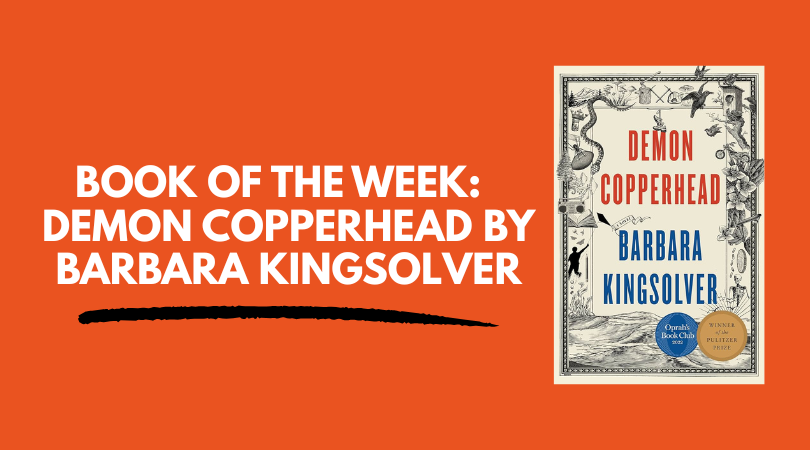
Have you ever read a book that made you grateful for your own childhood while also making you ache for the kids who never had a fair shot at one?
That was Demon Copperhead by Barbara Kingsolver for me.
This is not a casual little book you pick up, skim through, and politely place back on the shelf while pretending it changed your life. This book demands something from you. It asks for your attention, your patience, your compassion, and, at times, your willingness to sit with discomfort. It is long, emotional, funny, painful, and beautifully written. It is also one of the best books I have read this year.
Actually, let me say that more clearly.
Demon Copperhead is the best book I have read so far in 2026.
This book is a modern Appalachian version of Charles Dickens’ David Copperfield, but do not let that make it sound like some dusty classroom assignment that comes with a worksheet and a teacher asking you to “identify the symbolism.” Barbara Kingsolver takes that old framework and plants it deep in the soil of Appalachia, where poverty, pride, addiction, humor, love, neglect, survival, and stubborn hope all grow together like weeds through cracked concrete.
At the center of it all is Demon, a boy born into a life he did not choose, surrounded by adults who often fail him, systems that should protect him but do not, and circumstances that keep stacking against him like a bad poker hand dealt by a blindfolded dealer with a personal grudge.
And yet, Demon is not just a victim. That is what makes the book so powerful. He is funny, observant, loyal, talented, flawed, stubborn, loving, and frustrating in the way real people are frustrating. You root for him, even when he makes you want to reach through the pages and shake some sense into him. You laugh at his honesty. You ache at his losses. You get proud of him when he finds strength. And by the end, you feel like you have watched a boy crawl through the wreckage of his life and still somehow find a path worth walking.
A Kid Born Into the Wrong Hand
Demon enters the world already behind. He is not born into comfort, structure, education, or stability. He is born into a broken home, and not the kind of broken that can be fixed with a new coat of paint and a motivational quote on the kitchen wall. His mother is struggling, vulnerable, and drawn toward men who bring more damage than help. Demon pays for those choices, because that is often how life works for kids in broken homes. The child does not create the chaos, but the child still has to live inside it.
That is one of the great truths this book captures. Children rarely choose the mess they are born into, but they are often expected to carry the consequences.
Demon’s mother loves him in her way, but love without stability can still leave a child hungry, scared, confused, and unprotected. The men she allows into their lives do not bring rescue. They bring danger, neglect, and disappointment. Demon is a kid trying to understand the world while the adults around him keep making it harder to survive.
That part of the story made me think about the families I grew up around. I was fortunate. My family was intact. I had a loving home, a mother and father who cared, and a dad who came from nothing but did everything in his power to make sure we did not stay there. He understood struggle because he had lived it, and because of that, he worked hard to keep us away from the kind of situations Demon is forced to endure.
But I saw those situations around me.
I saw kids grow up in homes where the adults were overwhelmed, absent, addicted, angry, or simply not equipped to guide a child through life. I saw families doing their best with very little money and even less support. I saw single moms trying to hold life together with two hands while the whole world kept tugging at their sleeves. I saw kids who were funny, athletic, smart, and full of potential drift toward drugs, alcohol, bad crowds, and bad decisions because nobody was standing close enough to redirect them.
When you are young, you do not fully understand what you are seeing. You just know who has snacks at their house, who has parents that yell, who has a bike, who does not, who can stay out late, and who seems to be raising themselves. Later in life, after you become a father, a business owner, and a leader responsible for other people, those memories look different. You start to realize some kids were carrying weight they never should have had to touch.
That is where this book gets under your skin. Demon is fictional, but the world he represents is very real.
The Dream of Something Better
One of the most memorable threads in the book is the promise of the beach. For many people, a trip to the beach is simple. You pack a cooler, complain about traffic, forget sunscreen, and spend half the day shaking sand out of places sand was never invited.
For Demon, the beach becomes something much bigger.
It becomes a dream. A symbol. A promise that maybe life might offer him something good, something normal, something beautiful beyond the hardship he has always known. And then, time after time, that dream is delayed, taken away, or pushed just out of reach.
That may sound small until you understand what it means for a kid like Demon. Poverty does not only take away money. It takes away certainty. It takes away consistency. It takes away the simple joy of being able to believe that something good promised today will still be there tomorrow.
That forever trip to the beach is one of the quiet heartbreaks of the book because it captures what disappointment feels like to a child. It is not always the giant tragedy that breaks someone. Sometimes it is the constant erosion of hope. The little promises that vanish. The normal experiences everyone else seems to have that somehow never arrive for you. The feeling that every good thing in life comes with an asterisk, a delay, or a catch.
Demon has dreams. He wants love, friendship, belonging, and a future. He wants to be more than the circumstances that shaped him. He finds pieces of that hope in sports, in friendships, in the Peggots, in Maggot, in Angus, and in the people who give him glimpses of what life could be if the ground beneath him would stop collapsing.
That is what makes him so easy to root for. He is not asking for the world. He is asking for a shot.
Talent, Trouble, and the Road to Oxy
Sports become one of the places where Demon can see a different version of himself. That part of the book felt especially real to me. Anyone who grew up around sports knows what they can do for a kid. Sports can give structure to someone who has none. They can give identity to a kid who feels invisible. They can give confidence, discipline, friendship, and a reason to believe that the future might be bigger than the neighborhood you started in.
For Demon, football offers that possibility. He has talent. He has toughness. He has the kind of ability that makes people notice him for something other than his hardship. But like so many things in his life, even that gift becomes complicated.
The situation with his coach, the pressure around the program, and the one play that changes the direction of his life all become part of a larger tragedy. Demon gets hurt. Pain enters the picture. Then come the pills. Then comes Oxy. And suddenly the road beneath him shifts from difficult to dangerous.
What makes Kingsolver’s writing so effective is that she does not treat addiction like some cartoon villain that jumps out from behind a tree. She shows how it can start quietly, almost logically. A kid gets injured. A trusted adult wants him back on the field. Pain needs to be managed. Pills are handed out. A system that should protect him instead becomes part of the machinery that pulls him under.
That is the terrifying part.
Addiction does not always arrive looking like rebellion. Sometimes it arrives wearing a white coat, holding a prescription bottle, and telling a hurt kid that this will help.
Demon’s fall into Oxy is not just his personal failure. It is part of a much bigger failure involving poverty, healthcare, sports pressure, adult negligence, and a region being swallowed by an epidemic too many people were too slow to confront. Kingsolver shows the human side of that crisis through one boy’s story, and that is what makes it land.
You are not reading statistics. You are watching a kid you care about get pulled into the current.
The People Who Shape Him
One of the strengths of Demon Copperhead is that the supporting characters are not decorations. They matter. They shape Demon. They challenge him, tempt him, hurt him, and help him survive.
Fast Forward is one of the most unforgettable examples. He is charismatic, talented, exciting, dangerous, and exactly the kind of person young people follow before they understand the cost of following the wrong leader. He has swagger. He has confidence. He has that magnetic pull that makes people want to be near him, even when something about him tells you to keep your distance.
We have all seen someone like that. The person who makes trouble look like adventure. The person who can turn bad judgment into a group activity. The person who seems like a leader because they are bold, when really they are just reckless with better posture.
Fast Forward’s story and his ending add another layer to the book’s examination of influence, ego, and consequence. I do not want to give away the full weight of it, but his path reminds you that not everyone who pulls you forward is leading you somewhere worth going.
Then there are the Peggots, Maggot, and Angus. These relationships are the emotional anchors of the book. They show that family is not always defined by blood, and survival is rarely something a person does alone. Demon’s loyalty to them says a lot about who he is underneath the damage.
He is not perfect. Good grief, he is not perfect. There are moments where Demon’s choices make you want to close the book, walk around the room, and hold a small leadership meeting with yourself about patience.
But he knows love. He understands loyalty. He wants to be true to the people who matter to him. Even when life keeps giving him reasons to become bitter, selfish, or hard, there is still something decent inside him fighting to stay alive.
His love falling prey to drugs is another painful part of the story because it shows how addiction does not just take one person. It reaches into families, friendships, relationships, and entire communities. It steals futures in slow motion. It changes people while the people who love them are forced to watch.
Demon loses his mother. He sees people he loves suffer. He gets knocked down by poverty, addiction, bad decisions, broken systems, and betrayal. The pile keeps growing. The weight keeps getting heavier. And still, somewhere inside him, he keeps searching for the right path.
That is what makes the story more than tragic. Demon is not merely a kid who suffers. He is a kid who suffers and still keeps some part of himself intact.
Why This Book Stayed With Me
The reason Demon Copperhead stayed with me is not because it is sad. A sad book is easy to write. Just hurt everyone, kill the dog, add rain, and call it literature.
This book is different because it is alive.
It is funny in the middle of pain. It is tender without being soft. It is angry without being preachy. It shows hardship without turning people into stereotypes. It gives dignity to people who are often ignored, judged, or reduced to statistics.
That is what great storytelling does. It makes you see people more clearly.
Demon’s life reminded me of kids I grew up around. The ones running through the woods, riding bikes, getting dirty, finding trouble, and creating adventures out of nothing more than trees, trails, creeks, and a few buddies who were usually just as unsupervised as they were. It reminded me of first love, high school, sports, Friday nights with the boys, and cruising around town like we owned the city when we barely had enough gas money to get home.
But it also reminded me of the other side. The families under pressure. The kids without guardrails. The young people who found drugs or alcohol before they found direction. The single mothers carrying more than anyone could see. The fathers who were absent, broken, or never taught how to be fathers in the first place.
And it made me grateful.
Grateful that I had a family that fought for me. Grateful that my father came from nothing and still found a way to build something better for us. Grateful that I had love, discipline, and standards around me, even when I did not fully appreciate them at the time.
Demon was given a bad start, but he does not let that become the entire story. That is the beauty of the book. He gets dragged through more than any kid should have to endure, but he keeps finding ways to turn life’s lemons into lemonade.
Now, to be clear, sometimes that lemonade is warm, sour, and served in a cup you probably should have washed twice. But he keeps trying.
And that matters.
Final Thoughts and Golden Squeegee Rating
If you want to read a modern, Appalachian-style version of Dickens, pick up Demon Copperhead and prepare yourself for a real journey.
And I say journey on purpose.
This book is not a roller coaster. A roller coaster has a track, a safety bar, and somebody making sure the bolts were inspected before you got on.
This book is a trip to Antarctica in a rowboat with two missing oars and a raccoon in charge of navigation.
It is long. It is cold in places. It is rough. It is funny when you least expect it. It makes you wonder if you are going to make it to the end, then somehow, when you do, you are grateful you took the trip.
You are going to root for Demon. You are going to laugh at Demon. You are going to get frustrated with Demon. You are going to be proud of Demon. And maybe, if you are like me, you will recognize pieces of your own life in his story, or at least in the lives of people you knew growing up.
The woods. The friendships. The first love. The sports. The Friday nights. The hard choices. The people who made it. The people who did not. The family that helped keep you on the right path.
Demon Copperhead gets 5 out of 5 Golden Squeegees.

No question.
This book is officially on my Top Books of 2026 list, and the full list will come out at the end of the year. But I can already tell you this one is going to be hard to beat.
Get yourself a copy. Brace yourself for the journey. And when you finish it, take a minute to think about the people who helped keep you standing, because not everyone gets that gift.
Keep Shining.
