
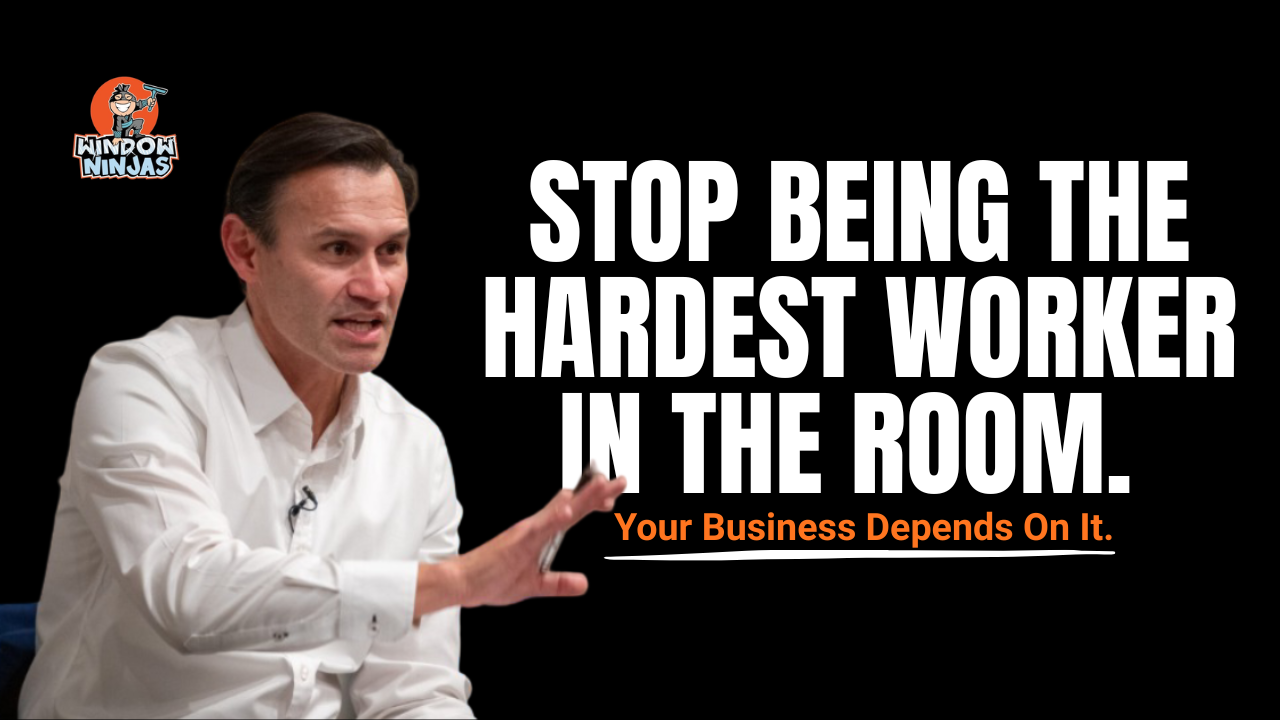
You built something real. You outworked everyone around you to get here. Now it’s time to stop.
I know that sounds wrong. Everything in your gut is telling you that working harder is how you got here, so working harder must be how you stay here. That logic made sense when you were starting out. It doesn’t anymore.
If you are still the hardest working person in your own business after year three, you don’t have a business. You have a job. A job you can’t quit, can’t sell, and can never fully walk away from without the whole thing falling apart.
I lived this. I’m not theorizing from a business school classroom. I’m talking about 34 years in the window cleaning industry, building Window Ninjas from the ground up, making every single mistake I’m about to describe to you.
And the one that nearly cost me everything? I was too proud of my own hustle to let go of it.
The Badge of Honor That Becomes a Prison
There’s a culture in entrepreneurship that glorifies the grind. Sixty-hour weeks. First one in, last one out. No days off. You see it everywhere, and it gets celebrated like it’s some kind of moral virtue.
Early on, it kind of is. When you’re bootstrapping something from nothing, you put your back into it. That’s real. That’s required.
But there’s a moment, somewhere in the growth of every business, where the founder has to make a choice. Either you build something bigger than yourself, or you become the ceiling of your own operation.
Too many entrepreneurs never make that choice consciously. They just keep grinding. And the business grows just enough to demand more of them, and more after that, until they are so buried in the day-to-day that they can’t see the exit anymore.
I’ve had franchise owners come to me who worked harder inside their franchise than they ever did as an employee. They bought what they thought was freedom. What they actually bought was a more expensive version of the same trap they were trying to escape.
That’s not a franchise problem. That’s a mindset problem.
Operators Run the Machine. Architects Build It.
Here’s the shift that changed everything for me.
I stopped thinking like an operator and started thinking like an architect.
An operator asks: what needs to get done today?
An architect asks: who is going to do this, how will they be trained, how will I know it was done right, and how does this process scale without me touching it?
Those are completely different questions. And the business you build depends entirely on which one you’re asking.
When I was deep in operator mode, I was the answer to every problem. Crew short-staffed? I’d pick up a squeegee. Customer complaint? I’m on the phone. Tech issues with scheduling? Let me figure it out. I was good at all of it. And being good at all of it was the problem.
Because when you are the answer to everything, nothing works without you. Your team stops developing problem-solving skills because they know you’ll just solve the problem. Your systems stay weak because there’s no urgency to strengthen them when a capable human is available as a workaround.
You become the single point of failure in your own operation.
What Real Systems Actually Do
People hear the word “systems” and think: paperwork, manuals, corporate bureaucracy. That’s not what I’m talking about.
A system is any process that produces a consistent result without depending on a specific person’s judgment or presence.
It’s a checklist a new tech can follow on day one and produce work you’d be proud to put your name on. It’s a customer communication sequence that runs on its own and keeps your clients informed without anyone having to remember to make a call. It’s a hiring profile that helps you identify the right person before you waste three months finding out they’re the wrong one.
Systems are how you clone yourself without being there.
At Window Ninjas, systems are the foundation of the entire franchise model. When a new franchisee joins, they’re not learning how Gabe Salinas does things. They’re plugging into a set of processes that have been refined over decades. The system is the product. The franchisee is the operator of the system, and over time, the architect who grows it.
That distinction matters because it means the business can run, grow, and eventually be sold without any single person being irreplaceable. Including me.
Hiring Changes When Your Thinking Does
Once you make the mental shift from operator to architect, you start hiring differently.
Operators hire for task execution. They want someone who can do the thing they need done. Architects hire for judgment, ownership, and growth potential. They want someone who will eventually figure out how to do the thing better than they could have.
I look for what I call hungry wolves. People who are self-motivated, who don’t need to be chased for results, who eat what they kill. That kind of person doesn’t just fill a role. They expand it.
And when you have the right people in the right seats, running well-designed systems, something remarkable happens: the business starts running without you needing to be in the room.
Not because you abandoned it. Because you built it that way on purpose.
Freedom Was the Point
Here’s what I want you to sit with for a minute.
Why did you start a business in the first place?
For most people, somewhere in the honest answer, is freedom. Time freedom. Financial freedom. The freedom to choose how you spend your days. The freedom to build something that outlasts you.
None of that is possible if you’re the hardest worker in your own building.
Time freedom doesn’t come from working more efficiently. It comes from building an operation that produces results without requiring your constant presence. Financial freedom is sustainable only when the business can generate revenue without your personal labor as the fuel.
And if you ever want to sell? A business where the owner is the business is nearly impossible to transfer. A buyer isn’t purchasing your personal hustle. They’re purchasing a system, a brand, a customer base, and a team that can continue producing results the day you hand over the keys.
Buy with the exit in mind. Build with the exit in mind. Even if you never sell, that mindset forces you to create something real.
The Shift Starts with One Question
You don’t have to overhaul everything overnight. You just have to start asking a different question.
Every time you solve a problem yourself, ask: how do I make sure this problem doesn’t require me next time?
That one question, asked consistently, is how you move from operator to architect. It’s how you build documentation, develop your team, tighten your systems, and slowly, methodically, remove yourself as the bottleneck.
Your business should be able to run a full week without you. Then a month. Then longer.
If that idea makes you uncomfortable, good. Sit with that discomfort. It’s telling you exactly where the work is.
You’ve already proven you can outwork anyone in the room. Now prove you can build something bigger than any one person.
Including you.
Keep Shining.
