I want to tell you a story.
Early in the Window Ninjas saga, we hired like everybody else. Put an ad out. Get a pile of resumes. Bring them in one at a time. Shake hands, look them in the eye, and then make a decision based on vibes, hopes, and crossed fingers. It was basically reaching into a hat and praying you grabbed a rabbit instead of a rattlesnake.
One day, a girl came in for an interview. Great attitude. Fun energy. Dressed well. Hungry for an opportunity. Me and my office assistant looked at each other and said, let’s roll with her.
What followed was a slow-motion disaster.
My office manager started going cross-eyed from the training it took just to get her up to speed. A few weeks in, the red flags were stacking up faster than closed deals. And then came the moment that ended the experiment for good.
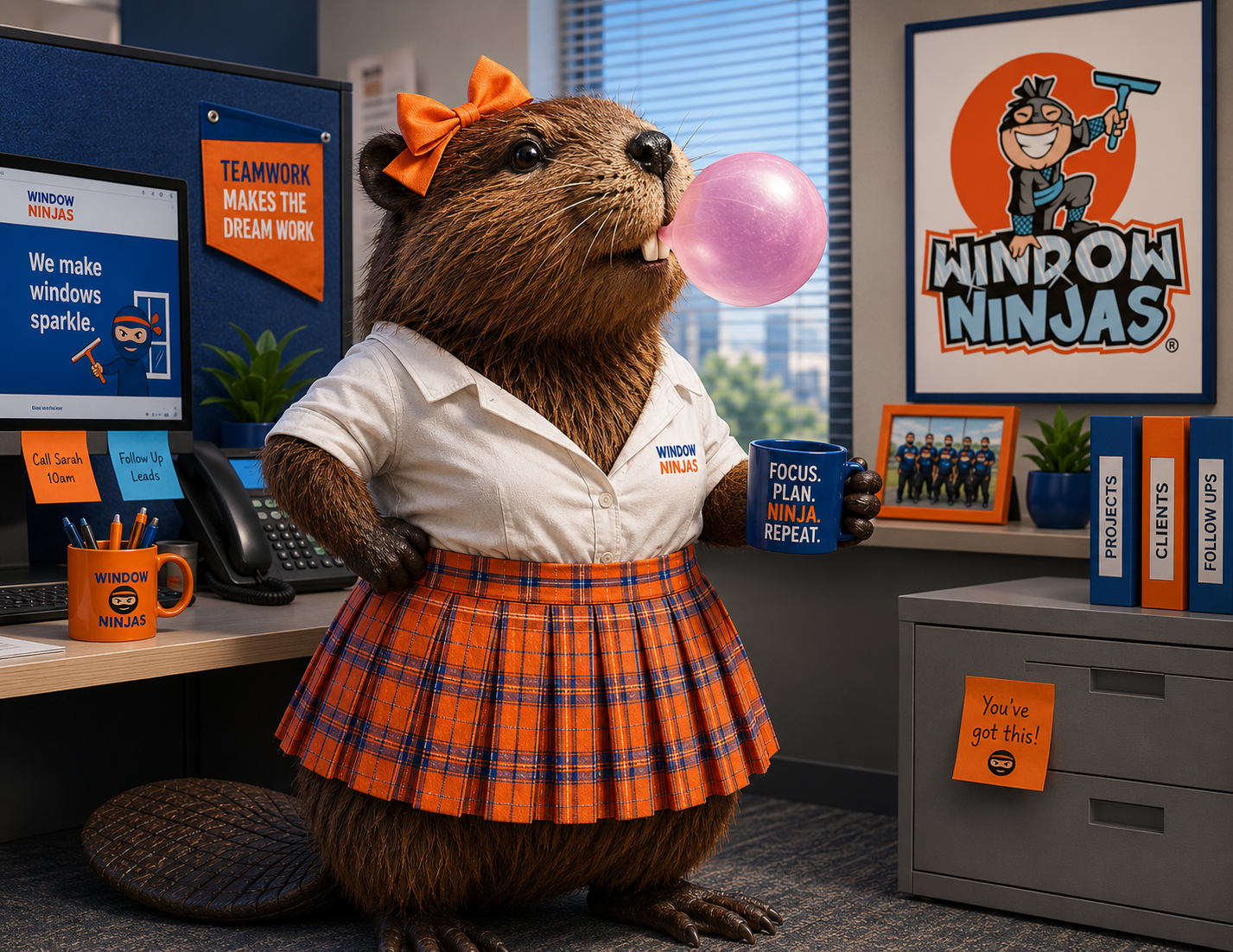
She was rushing to answer a phone and reached over the desk instead of walking around it. And suddenly, me and my office assistant were getting an eyeful of things that had absolutely no business being in a professional setting. No laundry had been done. Everything was flying free. And the two of us just looked at each other with the exact same thought.
Where did we go wrong with this one?
That was the beaver flash heard round the Window Ninjas office. And it changed everything about how we hire.
The Guessing Game Has a Price Tag
Here is what most small business owners don’t want to admit. Every bad hire costs you money. Not just the paycheck you wrote while they were figuring out they were in the wrong seat. You lose the time your manager spent training someone who was never going to make it. You lose the energy your team spent picking up the slack. You lose the deals that didn’t close and the customers who got a bad experience. And you lose the good candidate you passed over because you were too impatient to keep looking.
The guessing game is expensive. We just don’t track it that way.
About five years ago, we decided we were done paying that price. We were tired of hiring on hope and feeling. There are a lot of great people in the world. But a great person in the wrong seat is still a problem. And we kept putting great people in the wrong seats.
So we built a system.
What the System Looks Like Today
It is not complicated. But it does require patience. And patience, as it turns out, is the whole point.
Job ads go up on Thursday. Every respondent gets a reply with specific instructions. If those instructions are not followed to the letter, they don’t get called back. That first filter alone tells us more than most interviews do. If someone can’t follow simple directions when they are trying to impress you, what do you think happens after they get comfortable?
From there, we run a group interview. It saves time, and watching how candidates carry themselves in a room full of other candidates is its own kind of data.
If they make it through that, they get a one-on-one invite and a behavioral assessment. Not a quiz. Not a personality test. A real assessment that measures natural tendencies, behavioral strengths, and where a person is actually wired to thrive.
If they show up again and score well, they move to a final conversation with our leadership team. And then we make a decision based on facts, history, and assessment results. Not hopes. Not feelings. Not the sniff test.
Is the process long? Yes. Is it worth it compared to the beaver flash situation? Without question.
What the Assessment Tells You That the Interview Cannot
Here is the piece that changed everything for us.
People can interview well. They can say the right things, dress the right way, give you eye contact and a firm handshake and answers that sound exactly like what you were hoping to hear. And they can still be completely wrong for the role.
The assessment does not care about any of that. It measures what a person is naturally good at. Their wiring. Their instincts. Where they thrive without having to force it.
We have had people come in for service technician roles who scored off the charts for inside sales. We have had candidates applying for sales jobs who turned out to be built for detail-oriented operational work. Their attributes do not lie, even when they are trying to.
So instead of jamming them into the role they applied for and hoping it works out, we look at the score and ask a different question. Where does this person actually belong? And if we have a seat for them there, it becomes a win for everybody.
Nobody wants to be put in the wrong seat. But it happens constantly in small businesses because we hire on gut instinct and then wonder why the turnover never stops.
The Turtle Beats the Rabbit Every Time
I run into business owners all the time who tell me they are too busy for this kind of process.
And I tell them that is like saying they are too busy to make ten million dollars, so they’ll just settle for one million. You are burning time and money on the back end of every bad hire while refusing to spend a fraction of that on the front end of a real process. It does not add up.
Ford has a hiring system. Toyota has a hiring system. General Motors has a hiring system. What makes your window cleaning company or your landscaping business or your home services operation so different that you get to skip that step?
You don’t. You just told yourself you did.
The businesses that are scaling, that have lower turnover, that have teams running smoothly without the owner putting out fires every day. Those are the businesses that stopped hiring with their feelings and started hiring with a process.
We made that shift about five years ago. The system is not perfect. Nothing is. But compared to where we were? It is not even close.
Build Your Seat Chart Before You Fill the Seats
Here is the last thing I want to leave you with.
Before you post the next job ad, know what seat you are trying to fill. Not just the job title. The actual profile. What does a great person in this role look like? What are they naturally good at? What do they love doing on their best day at work?
Then build a process that filters for that. Make them follow instructions. Watch how they show up under pressure. Use an assessment to validate your instincts before you commit.
The right people are out there. They want to ride your airliner. They want to be in the right seat. Your job is to build the process that finds them.
And if you are still hiring out of a hat and hoping for the best, just know that the beaver flash is coming for you too. It is only a matter of time.
Learn from mine. Build the system. The turtle wins every time.
Golden Squeegee Rating: N/A (This one’s real life, not a book. But it gets five squeegees for the lesson it taught us.)
