Why brand protection is not being a jerk, it is part of building something that can outlast you
Have you ever had to make a phone call you knew was going to be awkward before the person even picked up?
Not awkward like, “Hey, you have spinach in your teeth.”
I mean awkward like, “Hey, I know you are trying to build your business, feed your family, make some money, and do your thing, but we have a problem.”
That was me yesterday.
I had to call a guy in Lawrence, Kansas. He owns a window cleaning company. I am sure he is trying to hustle. I am sure he is trying to build something. I am sure he has bills, customers, equipment, headaches, and all the normal fun that comes with running a service business.
So why did I call him?
Because of name rights.
More specifically, because of the Window Ninjas name.
Now, let me say this right up front. These calls are not fun. Nobody wakes up, pours a cup of coffee, looks out the window, and says, “You know what would make today special? A trademark conversation with a heated business owner in Kansas.”
Nope.
But when you build a brand, you have to protect it. You do not get to spend years building name recognition, reviews, customer trust, SEO value, franchise systems, trucks, uniforms, websites, logos, signs, marketing, and national brand presence, then shrug when someone else starts using something close enough to confuse people.
That is not being nice.
That is being careless.
And in business, carelessness gets expensive.
A Name Is Not Just a Name
A lot of people think a business name is just a couple of words slapped on a shirt.
It is not.
A name becomes reputation.
A name becomes trust.
A name becomes what people search for when they are ready to buy. It becomes the thing customers remember when their neighbor asks, “Who cleaned your windows?” It becomes the phrase people type into Google. It becomes the logo on your trucks, the voice on your phone calls, the promise behind your work, and the feeling people associate with the experience you deliver.
Window Ninjas is not just a cute name with a guy holding a squeegee.
It is decades of work.
It is sweat, ladders, trucks, customers, mistakes, lessons, service calls, five-star reviews, franchise meetings, training systems, legal bills, marketing bills, and a whole lot of early mornings when most people were still negotiating with their alarm clock.
So when someone uses a similar name in the same industry, it is not harmless.
Customers can get confused. Search engines can get confused. Vendors can get confused. Franchise prospects can get confused. And if something goes wrong, that confusion can land in my lap.
What if a customer in Kansas thinks they are calling us?
What if his customers start calling my team?
What if my team spends time answering questions, explaining the difference, or cleaning up confusion we did not create?
What if someone using a similar name does poor work, damages property, or creates a customer service mess?
God forbid someone blows up a building, floods a house, ruins a couch, or turns a simple window cleaning job into a crime scene with a squeegee.
Guess what people remember?
The name.
That is why brand protection matters.
Due Diligence Is Part of the Game
Here is where the truth gets a little uncomfortable.
If you are starting a business, you have a responsibility to research the name.
Not just ask your buddy.
Not just check if the Instagram handle is available.
Not just say, “Well, nobody in my town is using it.”
Not just flip two words around and act like you invented fire.
That would be like me going into the soda business and calling my product Ekoc, putting it in a red can, using cursive letters, and then saying, “What? It is totally different. Mine is spelled backward. Plus I used Pepsi blue on the stripe.”
Come on, man!
At some point, common sense needs to walk into the room, take off its sunglasses, and say, “Really?”
Business has rules.
You may not like the rules. You may not understand all the rules. You may think the rules are annoying, expensive, or inconvenient. Welcome to business. Pull up a chair.
But rules are part of the game.
The people who win long term usually do not win because they avoided the rules. They win because they learned them, respected them, and used them properly.
You lose when you assume the rules do not apply to you.
I have seen this for more than 30 years.
Somebody skips the homework. Somebody takes a shortcut. Somebody assumes nobody will notice. Somebody thinks, “I am just a small business. What is the big deal?”
Then the phone rings.
Now they are mad.
But being mad does not erase the homework you skipped.
Protecting the Brand Does Not Make You the Bad Guy
When I called this guy, I tried to be friendly.
I told him I appreciated what he was doing. I understood he was a solo operator. I understood rebranding would be a pain. I understood the conversation was not pleasant.
And I meant it.
Rebranding stinks.
Changing your name, your website, your shirts, your logo, your listings, your Google profile, your cards, your invoices, your customer communication, all of it is a headache. I get that.
But here is the question.
Is it my responsibility to absorb the consequences of someone else not doing their due diligence?
That might sound harsh, but business has a way of making the truth show up wearing steel-toed boots.
I did not create the problem by protecting my brand.
The problem was created when someone chose a similar name in the same industry without doing enough homework.
That is the part people miss.
When a business owner protects what he built, people sometimes act like he is being aggressive. But if he does not protect it, the brand can weaken. Customers can get confused. The market gets messy. The value of the company takes a hit.
You cannot say you want to build something that lasts, then act casual about protecting the foundation.
A brand is an asset.
And if you are building a business the right way, you protect your assets.
Attitude Changes Everything
Now let’s talk about attitude, because this is where business gets really interesting.
I can usually tell how a conversation is going to go within the first three sentences.
Some people listen. Some people ask questions. Some people may not like what you are saying, but they stay reasonable. They understand that two things can be true at the same time.
Yes, this is frustrating.
And yes, we still have to deal with it.
Then there are other people who get hot immediately. Harsh. Abrupt. Defensive. Not exactly floating through the conversation with the grace of a ballroom dancer.
More like talking to a goat who just lost his favorite patch of grass.
And listen, I get it. Nobody likes getting a call out of left field. Heck, this guy probably could not even see left field because he was busy looking behind himself wondering where the ball came from.
But your attitude matters.
It matters with trademarks.
It matters with customers.
It matters with vendors.
It matters with employees.
It matters when something goes wrong.
I have seen this over and over again in business. The people who stay calm, ask questions, and try to understand usually find better outcomes. The people who immediately blame, bark, and act like the world owes them a brand-new solution on a silver platter usually make everything harder.
That is not just a trademark lesson.
That is a life lesson.
Everybody Thinks the Business Can Absorb It
This is something people who have never owned a business often do not understand.
They think businesses can just absorb everything.
A customer gets confused and calls the wrong company?
The business can absorb it.
A team member spends time fixing an issue that should not exist?
The business can absorb it.
Someone damages your reputation by using a similar name?
The business can absorb it.
A homeowner replaces something without giving you a chance to inspect it, then sends you the bill?
The business can absorb it.
Can we please stop acting like businesses are magical money mattresses?
Every mistake costs something.
It costs time. It costs payroll. It costs focus. It costs opportunity. It costs energy. Sometimes it costs real money, and sometimes it costs something even worse, momentum.
Let me give you another example.
We recently washed an HOA property with 100 units. The job went well. The buildings were washed the same way. Plenty of units had digital door locks.
Then one owner says his lock stopped working after the wash.
Could we have caused it? Maybe. Let’s look. Let’s investigate. That is reasonable.
But before we could fully evaluate the situation, he replaced the lock and sent the receipt. The old lock was three years old, exposed to salt air, humidity, weather, and corrosion. It was already at the edge of its warranty life.
I offered to split the cost as a good-faith gesture because I understand inconvenience.
His response?
No. Your fault. Pay all of it.
Really?
That is like me taking the tires on my BMW back to the dealership and saying, “These were supposed to last 30,000 miles, but I only got 15,000.”
Then the dealer looks at them and says, “Sir, it appears you have been treating these tires like you’re auditioning for Fast & Furious: Wilmington Drift.”
And I say, “Your service sucks. You owe me new tires!”
“That is not how reasonable adults solve problems.”
Reasonable people look at facts. They ask questions. They consider age, condition, usage, maintenance, environment, and responsibility.
But unreasonable people skip all that and go straight to blame.
The Other Side of the Story
Now let me tell you the flip side.
I had an issue with a solar cell for my pool. It only lasted about three years. Replacement was around $2,500.
Did I love that?
Of course not.
I did not run through the house clapping like I won a raffle.
But I researched it. I asked questions. I had a conversation with my pool guy. I learned there were things we could do in the winter to help extend the life of the new one.
I asked for a discount.
He was happy to help.
Why?
Because I was reasonable. Because I have been a good long-term customer. Because I have referred people to him. Because I did not come into the conversation acting like a caffeinated courtroom attorney with a leaf skimmer.
Different attitude.
Different response.
Different result.
This is what people miss.
Being reasonable does not make you weak. It makes you effective.
Business Is a Game, But It Is a Serious One
Business is satisfying.
That is one of the reasons I love it.
You get to build something. You get to solve problems. You get to create jobs. You get to serve customers. You get to develop people. You get to compete. You get to take an idea and turn it into something real.
And if you do it right, you can build something that outlasts you.
That is powerful.
But the bigger the thing gets, the more responsibility comes with it.
You cannot protect a brand only when it is convenient.
You cannot enforce standards only when nobody gets upset.
You cannot follow rules only when they are easy.
You cannot build a national franchise brand and ignore confusion in another market because the conversation might get uncomfortable.
This is the part of being a CEO that people do not see.
They see the logo. They see the website. They see the social media. They see the franchise growth. They see the trucks and the reviews and the success.
They do not always see the awkward phone calls.
They do not see the legal bills.
They do not see the customer disputes.
They do not see the hours spent protecting the thing everyone else thinks just magically appeared.
But that is the job.
And after 30-plus years in this industry, I can tell you this with confidence.
The game rewards people who respect the game.
Learn the Rules Before You Blame the Referee
Here is the line I keep coming back to.
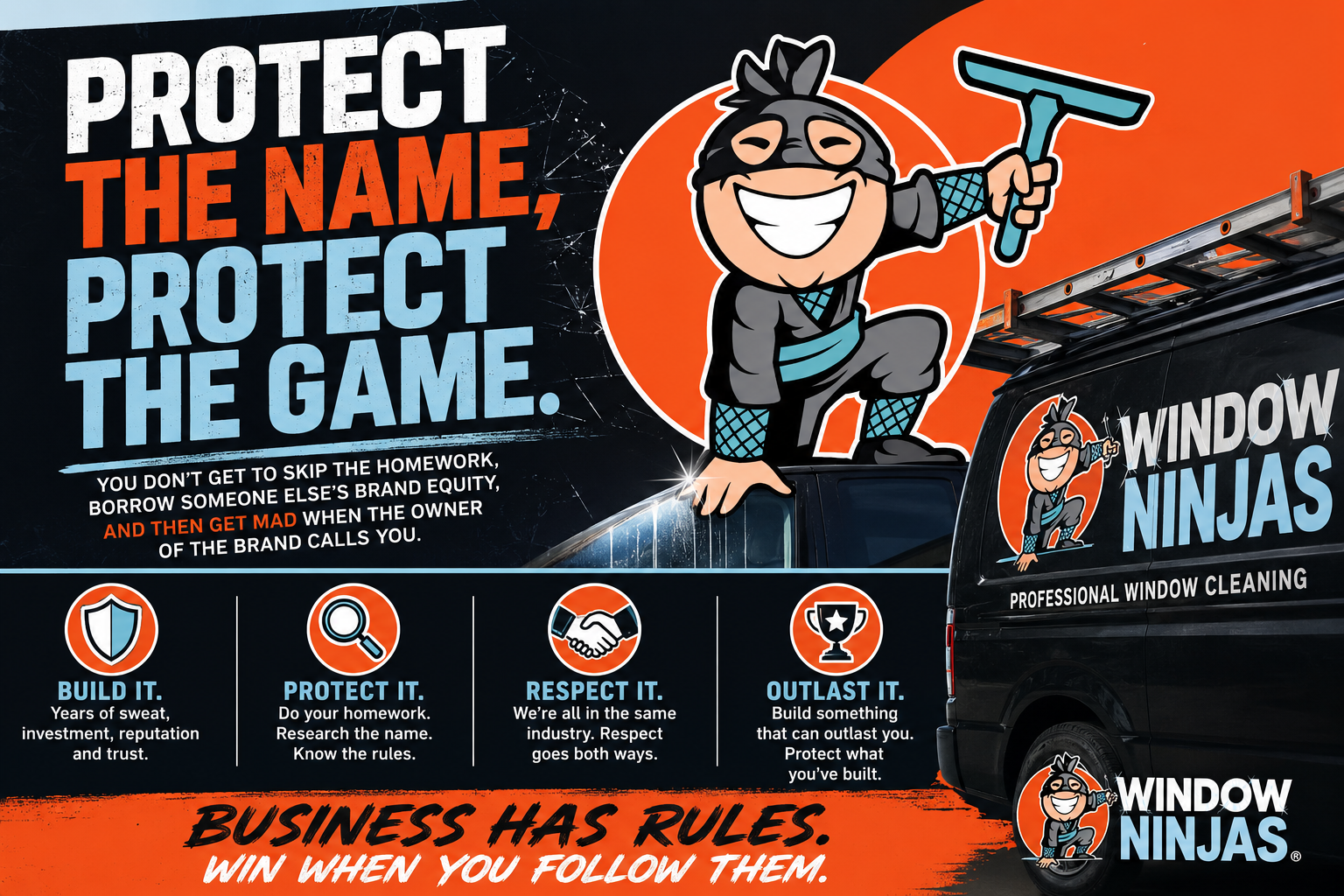
You do not get to skip the homework, borrow someone else’s brand equity, and then get mad when the owner of the brand calls you.
That applies to trademarks.
But it also applies to business in general.
You do not get to ignore the process and complain about the result.
You do not get to skip the pre-job walkthrough with the service tech and then act shocked when missing weather stripping becomes a problem.You do not get to replace the lock before the investigation and then demand full payment like the facts are an inconvenience.
You do not get to treat customers like they are interrupting your day and then wonder why your business is not growing.
You do not get to avoid due diligence and then blame the person who did theirs.
The truth hurts sometimes.
But damn, if it does not help.
If you want to build something real, learn the rules. Respect the process. Do the homework. Protect your name. Treat people fairly. Stay reasonable when things get uncomfortable.
And when someone calls you with a hard truth, maybe take a breath before you start swinging at the referee because you do not like the call.
Business is competitive, but it does not have to be ugly.
Most window cleaners I know are good people. They work hard. They help each other. They share advice. They refer jobs. They ask questions. They try to improve.
That is how it should be.
But respect goes both ways.
Respect the craft.
Respect the customer.
Respect the brand.
Respect the rules.
Because the people who do business with maturity, patience, and professionalism usually last longer than the ones who think anger is a strategy.
A name is not just a name.
A brand is not just a logo.
And protecting what you built is not being a jerk.
It is being responsible.
Keep Shining.
