
Ten o’clock yesterday morning. I walk into my office, get the usual rundown from my sales manager, and somewhere in the middle of it he drops this: one of our service managers is in the back. All day. No vehicle.
For a lot of businesses that’s a nothing sentence. My call center agents sit at desks. That’s the whole job. But a service manager parked in a chair is like a fire truck parked in a museum. Beautiful. Useless. He’s supposed to be out running quotes, checking crews, dropping off equipment, picking up equipment, being the guy who makes the day work. We even pay him to use his own truck for all that running around.
So where’s the truck?
Maintenance. Not a blowout on the highway, not an engine that let go without warning. Just something he’d been putting off. Could have handled it on a Saturday. Could have handled it any weekday we had a spare truck sitting at the shop doing nothing. Yesterday we didn’t have a spare, because we were slammed and every truck was out.
Fine. Annoying, but fine. Then came the part that actually stopped me.
My sales manager tells me he already drove him up the road to grab a rental car. And he came back without one.
Why?
No credit card. You can’t rent a car without one.
I stood there looking at this man like he’d sprouted a second head and started arguing with the first one.
Then I took a breath, grabbed my service manager, and said: let’s talk.
The Conversation Went Sideways Fast
Thirty-something years old. Makes a solid living. Kid at home, girlfriend at home. And when I started asking questions about how he handles money, the answers ran out almost immediately.
Not because he’s dumb. He isn’t. This guy can diagnose a squeegee problem from across a parking lot and run a crew that would eat most people alive.
He just never got the lesson.
And before I climbed too far up on my horse, I remembered something. Twenty-year-old Gabe was a disaster. Dumb, foolish, and absolutely clueless about how money worked. I thought a paycheck was the finish line. Cash it, spend it, wait for the next one. That was the entire strategy.
The only reason I stopped is that a few people sat me down and explained things I didn’t know enough to ask about.
Nobody had ever done that for him.
That’s not a character flaw. That’s a curriculum gap. They’ll teach you the Pythagorean theorem twice but not one word about compound interest, then hand you a diploma and a checking account and wish you luck.
So I started with what was sitting right in front of us. The card in his wallet.
Why I Told Him His Debit Card Is Garbage
I said it exactly like that, and he looked at me like I’d insulted his mother. Probably because nobody had ever said it out loud to him.
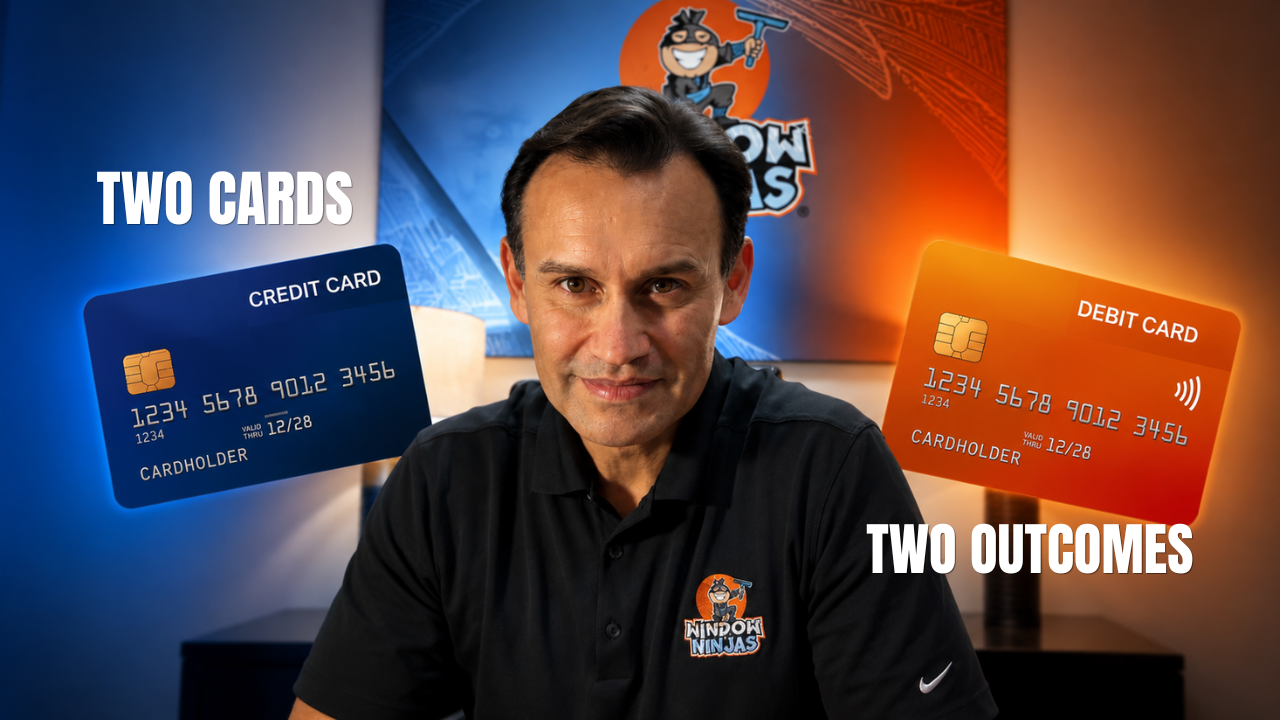
Here’s what a debit card actually is. It’s a straw stuck directly into your checking account. Whatever’s in there is your ceiling, and every swipe is money gone the same second.
Lose it on a Friday night and you’re locked out of your own money until Monday. Can’t buy gas. Can’t buy groceries. Can’t handle whatever life just threw at you. You’re holding a plastic rectangle that does exactly nothing.
Now here’s the question almost nobody thinks to ask.
What do you actually get for using it?
Nothing. You get nothing. The bank holds your cash, turns around and lends it out, earns on it all month, and hands you back a receipt for your trouble.
And when they tell you a benefit of opening a checking account is a free debit card, that’s a load of nonsense. That’s a landlord bragging that your apartment comes with a free key.
The Thirty Day Head Start
So I explained the other side of it.
A credit card gives you thirty days. Start on the first, put everything on it, and you don’t settle up until the statement comes due. Gas, lunches, dinner out, groceries, clothes, the stuff you were buying anyway. Your money sits in your account the whole time instead of evaporating at the register.
But the float isn’t even the good part.
The rewards are.
Everything I buy goes on a credit card, and I do it for one very specific selfish reason. I like to travel and I don’t like paying for first class. So every dollar I was going to spend regardless is quietly stacking points in the background.
Spend ten grand in a month and you’re looking at ten to twenty thousand points depending on the card and the categories.
A first class seat to Mexico runs fifteen hundred to eighteen hundred bucks. Points cover it.
Same spending. Same budget. Same money walking out the door either way. One version of that month puts me on a plane with legroom and a drink. The other version puts me in a middle seat next to a guy who brought his own tuna sandwich.
Then my service manager gave me the line I hear constantly.
“I don’t have a credit card. I don’t need one. I don’t want to get in trouble.”
That fear isn’t stupid. It’s just aimed at the wrong target.
The One Rule Nobody Explains
Most people are scared of credit cards because they’ve only ever seen one version of the story. Swipe, carry a balance, get hammered at eighteen percent, repeat until you’re making minimum payments on a couch you don’t even own anymore.
They watched a parent live through that and decided the whole tool is dangerous.
But that’s not the card. That’s the behavior.
The rule is one sentence: pay it off in full, every single month.
That’s the whole thing. Do that and you pay zero interest, keep every point, and build a credit history while you’re at it. Miss that one rule and it flips on you instantly. The interest eats the rewards and then keeps chewing.
Want proof the companies are counting on you to miss it?
Lose your debit card and watch how fast your bank moves. They’ll mail you one. Might take a week. Might take two.
Lose your credit card and it’s on your porch tomorrow morning. Overnighted. No charge. Nobody even sighs at you on the phone.
Why the difference?
Because a card in your hand is a card that gets swiped, and they’re betting most people won’t pay it off.
Be the customer they lose money on.
The Part I Almost Forgot to Tell Him
Here’s where it gets fun, and this is the piece most people never put together.
If your money is sitting in your account for thirty days instead of leaving at the register, that money should be earning something while it waits.
Most people keep their cash in a checking account paying essentially nothing. Some fraction of a percent, if that. The bank is delighted. They’re using your money, paying you a rounding error, and calling it a relationship.
Go find a high-yield savings or checking account instead. They’re not hard to find and they don’t require a minimum fortune to open.
Now run the play. Everything goes on the credit card. Your paycheck lands in an account actually paying you interest. It sits there for thirty days doing quiet work. At the end of the month you pay the card off in full and keep the interest.
You just got paid to spend money you were spending anyway.
That’s it. That’s the whole trick. Nobody’s getting rich off one month of interest and a few thousand points, but do it for ten years and tell me it didn’t matter.
So Here’s Exactly What I Told Him to Do
I don’t like advice that stops at philosophy. Here’s the actual assignment I gave him, in order:
- Get a credit card. Not five. One. Start there.
- Make sure it pays you something. Cash back if you just want the money back in your pocket. Travel points if you know there’s a trip you want to take. Pick based on how you actually live, not on what the commercial told you.
- Put every expense on it. Gas, groceries, restaurants, utilities, subscriptions, all of it. Rent too, if your landlord or property manager accepts cards without gouging you on the fee.
- Open a high-yield savings or checking account and park your money there while the card float does its thing.
- Pay the card off in full at the end of every month. In full. Not the minimum. Not most of it. All of it. This is the rule the entire system hangs on, and it is the one place you don’t get to negotiate with yourself.
That’s the play. It isn’t complicated. It’s just never explained.
I’m Not Going to Pretend It’s Free
This only works if you actually pay it off. Which means you have to know what you’re spending. Which means you need a budget.
Not a spreadsheet with forty tabs. Just an honest number for what comes in and what goes out.
Most people already carry a rough version of that in their head. If you know your number and you stay under it, running everything through a credit card is a smarter route to the exact same place you were already going.
But it takes discipline. It takes tenacity. And it takes time, because this is a skill, not a trick.
The information is out there and most of it is free. Blogs, articles, podcasts, financial sites. The young folks coming up today have access to more than I ever had at twenty. Which is exactly why it caught me off guard that he had none of it.
Access isn’t the same as instruction. Somebody still has to point at the thing and say this is what this is.
The Door Was Only the Beginning
The credit card was just the doorway. Once I was inside, I could see how much else nobody had ever walked him through.
Kid at home. Girlfriend at home. Not married. That’s his business and I’m not here to tell anybody how to build a family.
But here’s what he didn’t know, because nobody drew him the picture.
Filing separately means only one of them claims that child. She’ll likely claim the kid, and she isn’t earning much, so the credit lands where it does the least work. Meanwhile the guy actually covering most of the bills walks away with the smaller refund.
That’s thousands of dollars a year. Not lottery money. But thousands, every single year, quietly leaking out the side of the house because nobody ever handed him the blueprint.
Here’s the Part That Matters
I didn’t write this to embarrass anybody. That man is good people. Works hard, shows up, takes care of his crew. He just never got taught.
I’m writing it because I’d put real money on the fact that he isn’t alone. There’s a whole crowd out there running their entire financial life through a debit card, terrified of a tool that could be working for them, leaving refund money on the table, and assuming that’s just how it goes.
It isn’t how it has to go.
At Window Ninjas, we don’t just hand somebody a job and a squeegee. We hand them skills, real business education, and for the ones who want it, a path to running their own shop. Because if you win, we win. Every time.
Wealth doesn’t start with a windfall. It starts with somebody explaining the rules, and you deciding to run the plays.
Somebody did that for me thirty years ago when I was broke, foolish, and convinced I had it all figured out.
I’m doing it for my guy now.
Your turn. Open your wallet, look at what’s in there, and ask it one simple question.
What have you done for me lately?
