
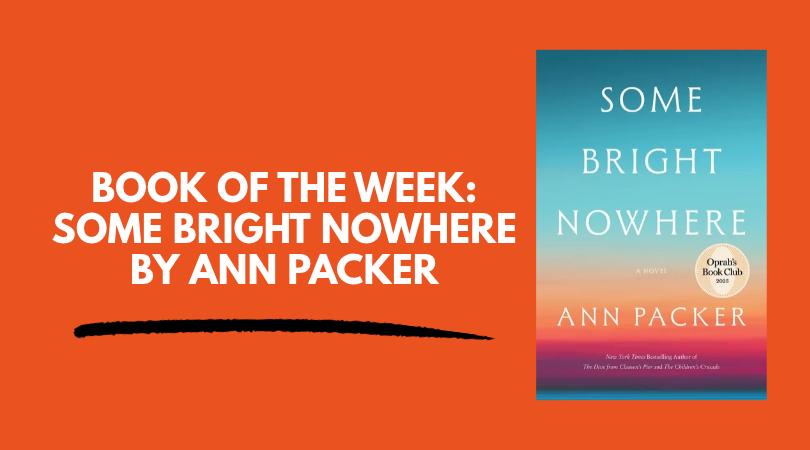
What would you do if the person you spent thirty five years loving looked you in the eye, near the very end, and asked you to leave the room?
That is the question Ann Packer hands you before you even finish the first chapter of Some Bright Nowhere, and she never lets you put it down for long enough to answer it comfortably.
I found this book scrolling through Oprah’s Book Club looking for something to knock the business books off my nightstand for a week. I was not prepared for what I got into. I picked up a novel. I put down a week of thinking about death, marriage, and what it actually means to show up for somebody.
The Setup
Here is the setup. Claire has been fighting cancer for eight years. She is down to her final months. Her husband Eliot has been there the whole time. Thirty five years of marriage, and every version of caretaking a devoted spouse can offer. Then Claire does something nobody in that house expected. She asks Eliot to step back and let her two best friends, Holly and Michelle, take over as her primary caregivers for the time she has left.
Eliot loves her. So he leaves.
My Honest Pushback
I have to be straight with you before I go any further, because that is how I operate. This book is genuinely interesting. Thought provoking from the first page to the last. But I read it as a guy who believes in spirituality, who believes in what it means to fall in love with somebody, take care of them, and follow through on that commitment when things get hard instead of when they are easy. And I will tell you, the lens this book is written through leans a certain direction. A reader who thinks about marriage as a covenant, not just an arrangement, is going to feel something get lost in translation here. I kept turning pages waiting for the book to sit with Eliot’s side of it the way it sits with Claire’s, and it mostly does not. That is my honest pushback. Doesn’t mean the book is wrong to exist. Means I read it with one eyebrow up the whole time.
Because here is what got me. If the person you built a life with told you, on their way out, that they wanted their final days spent with their girlfriends instead of you, how would that sit in your chest? I don’t care how evolved you think you are. That is going to cost something. The book knows it costs something too. It just spends more time on Claire’s reasons than on Eliot’s bill.
There Is No Right Way To Die
What kept me reading past my own resistance is the bigger truth underneath all of it. There is no right way to die. There is no wrong way either. Packer puts you inside a family trying to make a death comfortable, trying to give a dying woman exactly what she says she wants, and you watch how that effort ripples out. You take care of one need and another one gets quietly neglected. You give Claire her girlfriends and Eliot gets left standing in the driveway of his own marriage. Somebody is always paying for somebody else’s comfort. Nobody in this book gets to opt out of that math, and neither do you once you close it.
What really stuck with me is how many relationships get put under the microscope at once. The wife. The husband. The kids. The friends. The friends’ spouses. Coworkers on the edges of the story. Watch closely and you start to see who in that circle has something real underneath them, some actual spiritual center, and who is just going through the motions of caring because it looks right from the outside. Death has a way of doing that to a room. It strips the performance off people fast. Some folks step up in ways that surprise you. Others reveal they were never really there to begin with.
Female Friendship As Its Own Kind Of Marriage
There is a whole thread in this book about the difference between how women show up for each other and how a marriage shows up, and Packer does not shy away from it. Holly and Michelle bring Claire something Eliot cannot. Chatter. Tears that do not need explaining. Laughter that does not have thirty five years of history attached to it. I found myself respecting that even while I was rooting for Eliot in the next room. Female friendship gets treated in this book almost like its own kind of marriage, built over decades, tested the same way. That is not something I expected a book about dying to teach me, and it stuck.
I have sat in that kind of room before. I have watched a family try to make somebody’s last stretch comfortable, doing everything right by every measure they could think of, and still feel like they were failing somewhere they could not name. It is not a joyous experience no matter how much love is in the house. You can plan the most peaceful exit imaginable and somebody’s feelings are still going to get bruised on the way out the door, because dying does not run on a schedule that keeps everybody happy. If you have lived through it, this book will not tell you anything you have not already felt in your own bones. It will just put language to it.
Where This Lands On Business
Now here is where I always end up, because I cannot read a book without it landing on business somehow. Commitment does not get easier when it gets tested. It gets tested precisely so you find out if it was real. I built Window Ninjas by showing up on the days I did not want to show up, not the days it was easy to. Franchisees do not stay in the system because everything is smooth. They stay because somebody kept their word when it would have been simpler to walk. Marriage, partnership, ownership, it is all the same test wearing different clothes. Anybody can love somebody on the good days. The whole game is what you do on the days that cost you something.
Eliot did the hardest thing in this entire book, and the story barely gives him credit for it. He loved somebody enough to let her have what she needed, even when what she needed was not him. That is not weakness. That is the kind of ownership I respect in a business partner and in a marriage. You do not get to decide what love costs you. You only get to decide whether you pay it.
Think about the people around you who claim to be all in on something, a marriage, a business, a team, right up until the moment it asks them to bend instead of the other way around. That is when you find out who was actually committed and who was just enjoying the version of commitment that never cost them anything. Eliot found out what he was made of in the driveway of his own house. Most of us find out in far smaller moments, a hard season with a spouse, a partner who needs more than we planned on giving, a franchisee going through something rough who needs a phone call instead of a policy. The test rarely looks the way you expect it to. It just shows up and asks if you meant what you said.
The Golden Squeegee Rating

Golden Squeegee rating on this one. I am giving Some Bright Nowhere 4.4 out of 5. It loses ground with me for how one-sided the emotional camera stays for most of the book, especially toward a husband who did nothing but show up for thirty five years. But it earns every bit of that 4.4 for making me sit with questions I do not usually let myself sit with. What does a good death actually look like? What do I owe the people I love when I am the one running out of time. Who in my own circle has real spiritual weight, and who is just standing around looking the part. Any book that gets a guy who reads mostly leadership books to think that hard about mortality and marriage has done its job.
Read this one if you have ever loved somebody through something hard. Read it especially if you have ever wondered what your own ending might ask of the people around you. Just go in with your eyes open about the lens it is written through, and decide for yourself where you land on Eliot.
Keep Shining.
Follow my journey at gabesalinas.com, subscribe on Substack, and connect with me on social media.
